
Adam Hibberd I have a preprint out on the feasibility of the hypothesis that 1998 KY26 is actually the Phobos 1 probe, go here. I have already conducted extensive research into this possibility. Essentially, apart from physical similarities, the argument can be condensed into two important findings: (1) Two ΔVs caused by thrust from the […]
Starship Blog
With the recent creation of the new i4is website, along with the newer blogs, we have included a selection of previous Starship Blog posts from our archive which we hope you will enjoy browsing. If you would like to write an article and have it appear on our web site, then get in touch with us.
Halley Rendezvous – the problem of how to get to the comet and stay there.
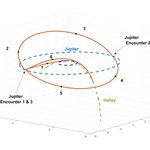
Adam Hibberd A rendezvous mission to Halley’s comet? The return visit of Halley to the inner solar system won’t be until around 2061, with perihelion on July 28 of that year. That’s a long way away, right? That hasn’t stopped some scientists deriving a trajectory to this well-known comet, designed to RENDEZVOUS with it (go […]
How long does it take to get to the Sun/Earth L4 Point from Earth?

Adam Hibberd Let’s say we eject a spacecraft with a small velocity decrement in the opposite direction to Earth’s own velocity around the Sun, what will happen to it exactly? It will stay around Earth’s heliocentric orbit since its velocity is close to Earth’s, however we shall assume that the spacecraft flies outside of Earth’s […]
What is 1998 KY26?
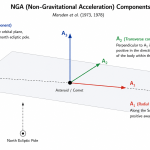
Adam Hibberd I was recently referred to a paper by Farnocchia et al which apparently, so was it argued, contradicted the notion that 1998 KY26 could be technogenic (man made), in other words a spacecraft. For the uninitiated, 1998 KY26 has always been considered (up-to-recently at least) a Near Earth Asteroid (NEA) of some form […]
The Clock is Ticking on Project Lyra

Adam Hibberd Where are the Interstellar Objects (ISOs)? A new observatory (Vera C. Rubin) has been operating for a month and has not yet found any. A month of Vera C. Rubin is probably not long enough for scientists to change models of their abundance. If nothing after a year? Maybe scientists might start considering […]
What’s up with 1998 KY26?
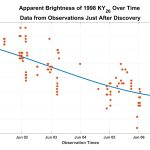
Adam Hibberd I’m not sure whether you might already be aware of this but there are really weird objects orbiting the Sun which astronomers have observed and tried to categorize as a new class of object, ‘the dark comets’. But what makes them weird? It’s the rather strange fact that the peculiar orbital paths they […]
Mission to an Interstellar Object
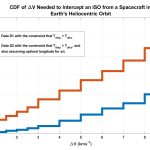
Adam Hibberd Many readers in-the-know will have heard of the future ESA ‘Comet Interceptor’ mission, due to launch in 2029. For those not-in-the-know it is a spacecraft desgined to loiter at the famous Sun/Earth Lagrange 2 (L2) point for a few years, waiting for a ‘pristine’ Oort Cloud comet to come flying in to the […]
2024 YR4, Which Rendezvous Plan?
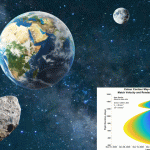
Adam Hibberd The object known as 2024 YR4 has laid down the gauntlet on humanity. ‘See me outside, or take the consequences!’ The consequences however would not be eternal dishonour and ignominy, but a complacent denial of the existential threat posed by Near Earth Asteroids (NEAs) such as this. True, a few weeks after its […]
A Mission to 3I/ATLAS by Solar Slingshot (a layperson’s guide).
Adam Hibberd This is how I’d explain my paper to a mate in a pub: “The Solar System is comprised of lots of different objects (like planets, asteroids and comets) which go around the central Sun, in huge ellipses. You may say the Earth’s path is circular, that’s true, but in fact all circles are […]
Sample Return Mission Feasibility of 2024 YR4
Adam Hibberd A mission to Near Earth Asteroid designated 2024 YR4 which for a while had a relatively high chance of colliding with the Earth. This probability has dropped to zero but instead the likelihood of impact with the Moon has gone up – it is now ~ 4 %. Such a collision would cause […]
A Challenge for OITS
Adam Hibberd I was recently asked by a US colleague to do a little research using ‘OITS’. For those of you unaware by now, ‘OITS’ stands for ‘Optimum Interplanetary Trajectory Software’ and is a powerful tool I developed single-handedly for studying the problem of sending spacecraft on heliocentric trajectories to a planet or for that […]
3I/ATLAS: Is It Worth a Solar Oberth?
Adam Hibberd Have you noticed, 3I/ATLAS is well and truly on its way out of the Solar System? It has afterall passed through its closest approach to the Sun (perihelion) and is well on its way to a close encounter with Jupiter in mid-March – given this, it would seem to be the ideal moment […]