• Skip to primary navigation
  • Skip to main content
  • Skip to primary sidebar
  • Skip to footer

Initiative for Interstellar Studies

Working towards the achievement of interstellar flight through knowledge to the stars - Starships in our lifetime

  • What we do
    • Education
      • Education
      • ISU Projects
      • Starship Engineer
      • SF Starships
      • STEM & Schools
      • Talk Series
      • Exploring Equations
      • LSI Summer Course
    • Technical
      • Project Dragonfly
      • Andromeda Probe
      • Project Glowworm
      • Project Lyra – Exploring Interstellar Objects
      • von Neumann AI Probe
      • Project World Ship
    • Sustainability
    • Enterprise
    • The Alpha Centauri Prize
    • X-Projects
    • I4IS-USA
    • In the media
  • Who we are
    • About Us
    • Board of Directors
    • Education
    • Researchers
    • Managers
    • Team i4is Gallery
    • Interstellar artists
      • David A Hardy
      • Adrian Mann
      • Alex Storer
      • Terry Regan
    • Contact us
  • Events
  • Publications
    • Principium
    • Axiom
    • Monographs & Reports
    • Books
    • App
    • Team Publications
    • Useful Resources
  • Blog
  • News
  • Members
    • Join Now
    • Login
  • Donate
You are here: Home / Starship Blog / Project Dragonfly competition workshop

Project Dragonfly competition workshop

25 September 2015

The Project Dragonfly Design Competition, organised by the Initiative for Interstellar Studies i4is was concluded on the 3rd of July in the rooms of the British Interplanetary Society (BIS). To choose the rooms of the society is no coincidence. The BIS conducted the Lunar Lander study in the 1930s, which foreshadowed in an almost uncannily precise way the Apollo mission. Forty years later, in 1978, the BIS presented the first design of an interstellar probe: Daedalus. And in 2015, it was a natural choice to choose the BIS’ rooms for what might again be the stage for imagining things to come: Four international teams, almost exclusively consisting of students, are going to present their design for an interstellar probe. And this time, things get small.

Project Dragonfly

Background

The field of interstellar studies can be divided into two categories. First, the field of interstellar studies is teaming with huge spacecraft, often as large and heavy as today’s largest skyscrapers. However, there is a second stream of concepts for interstellar spacecraft, beginning with Robert Forwards’ Starwisp probe and Freeman Dysons’ Astrochicken [1, 2]. These concepts stimulated thinking the opposite: How small can we get? A small interstellar probe has a fundamental advantage. It needs less energy to accelerate to the same velocity. This is particularly relevant for interstellar missions, as we usually talk about required energies that often surpass current global energy consumption. Hence, any reduction in size might considerably increase the feasibility of an interstellar mission. Figure 2 shows an overview of some of the most relevant interstellar concepts and designs. The columns indicate the mass of a spacecraft from a particular concept or design in orders of magnitude. The rows indicate the level of detail. High-level concepts often consist of a basic feasibility analysis. System-level designs go deeper and describe key spacecraft systems in considerable detail. Subsystem-level designs add additional detail to all relevant spacecraft systems. The objective of Project Dragonfly is to address the gap in the lower left: To design an interstellar spacecraft down to subsystem level, ideally with a mass below 10 tons.

Figure: 2: Some of the most relevant interstellar concepts and designs

The idea behind Project Dragonfly emerged in early 2013 when I visited Professor Gregory Matloff in New York. Greg is one of the key figures in interstellar research. That night we talked about different propulsion methods for going to the stars. We realized that nobody had yet done a design for an interstellar laser-propelled mission. Soon after this conversation Project Dragonfly was officially announced by i4is. The name “Dragonfly” was chosen in order to pay credit to Robert Forward, who wrote the novel “The Flight of the Dragonfly” in the early 1980s, featuring a laser sail spacecraft. Later in 2013, i4is organized the “Philosophy of the Starship” Symposium at the BIS, where first presentations on laser-propelled interstellar probes were given by Kelvin F. Long and Martin Ciupa. Further vital preparatory work was done by Kelvin that year that fed into defining the competition requirements. With the first set of requirements defined, we finally got to the point where we were able to organize an international design competition in 2014. The purpose of the competition would be to speed up our search for a feasible mission to another star, based on technologies of the near future.

The Project Dragonfly Design Competition focused on small, laser-sail-propelled interstellar probes. Why small and laser-sail-propelled? With getting small, we are following a trend which started in the last decade. With the emergence of the CubeSat Standard first universities and then companies started to develop satellites, often not larger than a shoebox. Today, NASA and ESA are even thinking about sending small satellites to the Asteroids and Mars [3, 4]. However, the spacecraft still needs to be big enough to get enough science data back, setting a lower limit to spacecraft size, sufficient to host and supply sufficient power to the communication subsystem.

Why laser-sail-propelled? Laser sails are similar to solar sails. They both use light pressure for accelerating the spacecraft. Solar-sail-based spacecraft are today developed by various space agencies and organizations, starting with JAXA’s Ikaros mission to Planetary Society’s LightSail 1. The elegance of solar sails is that they are scalable and use an abundant energy source: the Sun. Most types of solar sails could be used as a laser sail and vice versa. Hence, using a potential laser sail on a solar sail precursor would be possible in most cases. This would lower the barrier for testing a new type of sail, as operating a solar sail does not depend on a laser infrastructure.

Project Dragonfly leverages on these two technology trends, as they seem to be promising to realize an interstellar mission in a scalable way.

The Project Dragonfly Design Competition

In August 2014, international university teams were invited to participate in the competition. All candidate teams had to submit solutions to a problem set first. This problem set included a range of small problems that were intended to train the teams in the key areas relevant for the competition, such as the basics of laser sail propulsion, laser systems, and in-space communication systems. The objective of this initial problem set was two-fold. First, it was intended as an entry barrier for all teams that do not have a serious intention or the capabilities to participate in the competition. Eliminating teams that would not make the cut later on also had the purpose to avoid overburdening the reviewers. The reviewers we invited are very busy individuals. We wanted to use their time as effective as possible, giving them the opportunity to focus on the best teams. Second, the successful teams would be able to develop or strengthen their capabilities to solve the main competition task of designing a laser-sail-propelled interstellar probe. They would also get familiar with the existing literature on the topic and get a “feeling” for the subject.

The teams that were able to pass this hurdle were then confronted with the mission requirements. These requirements used the requirements developed during Project Icarus as a starting point. Project Icarus is an ongoing collaborative interstellar study between the BIS and Icarus Interstellar, in which I am participating [5]. However, the requirements were adapted and extended to the laser sail case. The requirements are depicted in Figure 3 in a graphical fashion.

Figure 3: Graphical representation of the Project Dragonfly requirements

Written out, the mission requirements are:

  1. To design an unmanned interstellar mission that is capable of delivering useful scientific data about the Alpha Centauri System, associated planetary bodies, solar environment and the interstellar medium.
  2. The spacecraft will use current or near-future technology. [5]
  3. The Alpha Centauri system shall be reached within a century of its launch.
  4. The spacecraft propulsion for acceleration must be mainly light sail-based.
  5. The mission shall maximize encounter time at the destination.
  6. The laser beam power shall not exceed 100 gigawatts
  7. The laser infrastructure shall be based on existing concepts for solar power satellites
These requirements were deliberately fine-tuned in order to be challenging. The 100 GW beam power requirement constrains the design space considerably. The particular value was selected as it constrains the mass of the spacecraft to tens of tons. Furthermore, it is a beam power that is very challenging to generate with an in-space infrastructure within the 21st century but not completely off. The 100 year time constraint sets a theoretical minimum average trip velocity of 4.3% of speed of light in order to reach the Alpha Centauri star system. With the power constraint only the spacecraft mass, its sail system parameters, and the duration of acceleration / deceleration are left as key variables. A long acceleration duration allows for reaching a high velocity. However, a long acceleration duration means that the laser beam has to be steered over long distances. This in turn makes pointing and focusing the beam challenging.

The science data requirement is also challenging to fulfill. If the teams decide to reduce the spacecraft mass, they need to shrink their communication system as well. However, communication over interstellar distances requires large amounts of power, if useful science data is to be collected and to be sent back.

The teams needed to navigate in this design space, making careful trade-offs between different parameters.

The competition included two intermediate stage gates and a final review of the reports. Each stage gate required a different set of deliverables that are commonly required for concept studies in the space domain, such as an initial feasibility analysis, a technology readiness assessment, and detailed calculations for key aspects of the mission. The stage gate process allowed us to check and adjust our expectations for the next stage of the competition and provide targeted support if teams were struggling in a particular area. Furthermore, each of the deliverables covered a vital aspect that is commonly needed for a concept study. The staged approach enabled the teams to work on a limited set of deliverables at each stage, reducing the difficulty of the overall task.

The competition wouldn’t have been possible with our reviewers and advisors. Fortunately, we were able to recruit experts with considerable experience in solar and laser sailing studies, such as Les Johnson, who is working as the Deputy Director of the Advanced Concepts Team at NASA and Bernd Dachwald, a German professor.

Four international teams, out of initially six contestants were able to take all hurdles and submit a final design report:

  • Technical University of Munich
  • University of Cairo
  • University of California Santa Barbara
  • CranSEDS, consisting of students of Cranfield University, UK, the Skolkovo Institute of Science and Technology in Russia, and the Uniersité Paul Sabatier in France.

These reports were this time graded by the reviewers. Furthermore, the teams were invited to present their designs at the final workshop in London, on the 3rd of July 2015.

The workshop

The main purpose of the workshop was to mimic a typical design review in the space sector. The teams would give a presentation, covering all vital aspects of their design and would then answer questions from the audience and review panel. The review panel consisted mostly of aerospace engineers. Notable members were the Executive Director of i4is, Kelvin F. Long, and Chris Welch, who is working as a professor at the International Space University.

The first team to present was the team from the Technical University of Munich. Their spacecraft would be accelerated up to a distance of 2.2 light years and a velocity of 9% of the speed of light. The laser infrastructure would be placed on the Moon. Their laser sail would consist of a graphene sandwich material. Deceleration is enabled by a staged magnetic / electric sail. The team chose this staged approach, as the magnetic sail is very efficient at high velocities but gets increasingly less efficient at lower velocities. The electric sail is capable of decelerating at lower velocities. The spacecraft reaches the Alpha Centauri system after 100 years. Communication is enabled by a laser communication system. Power is supplied, either by solar cells that generate energy from the laser beam or the electric sail, which generates electric power when flying through the interstellar medium.

Figure 4: The spacecraft of the Technical University of Munich. Sail is not to scale.

The overall spacecraft is relatively heavy, compared to the other designs. It’s mass is 14t. Part of the reason is that the team aimed at maximizing the payload mass. A higher payload mass leads to a higher scientific yield but also leads to a heavier communication system, due to the higher data rate. Another effect is that a heavier spacecraft needs a longer duration to accelerate, imposing pointing requirements on the laser optics that are difficult to meet. Another difficulty with the overall architecture of the mission is that the laser system is located on the lunar surface. Although in principle feasible, installing such a system is very costly, unless a large amount of in-situ materials are used.

Figure 5: UCSB team wafer spacecraft design

The second presentation was given by the UCSB team. This team’s design combined the highest number of innovative technologies. It distinguished itself in numerous ways from the other teams. First, the concept of the spacecraft was a “wafer-based” design. This means that the spacecraft is basically imprinted onto a chip with all spacecraft subsystem integrated into it. The sail would consist of a dielectric material with an extremely high reflectivity, in order to withstand the enormous power density of several gigawatts per square meter. Note that sunlight in Earth orbit has a power density of about 1.4kW per square meter. Hence, the power density of the laser is roughly a million times higher than what today’s spacecraft are usually facing. A highly reflecting surface avoids that part of the energy is absorbed by the spacecraft, immediately melting it. The spacecraft is also accelerated rapidly, within a distance of three astronomical units, up to a velocity of 25%c. The team was able to consider such high velocities, as the spacecraft does not contain any deceleration system. Using deceleration systems such as a magnetic sail or an electric sail would lead to significant deceleration durations that may nullify any decrease in trip duration as a result of the high cruise velocity. However, the lack of a deceleration system does not comply with the mission requirements. The laser is a phased-array fiber-fed laser.
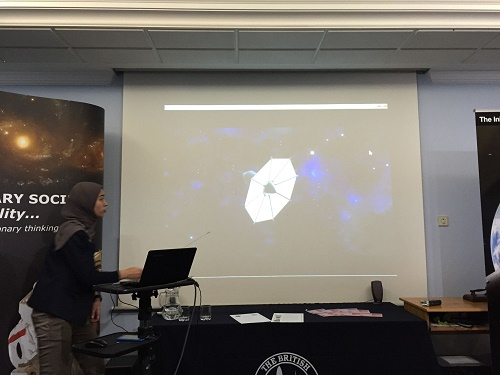
Figure 6: Samar Eldiary presenting the Cairo Team's spacecraft

The third presentation was given by the Cairo University Team. The team’s mission design is based on an initial acceleration via laser beam, based on the DE-STAR system developed by the UCSB team. The spacecraft is decelerated via magnetic sail, and then separates into two sub-probes. One probe will collect data from Proxima Centauri, the other data from the Alpha Centauri A and B system. The laser sail is made out of aluminum. A laser communication system is used for sending back data to the Solar System. Power is provided by three Radioisotope Thermoelectric Generators (RTGs). The team presented an innovative approach for attitude control during the acceleration phase by changing the shape of the sail.

Figure 7: CranSEDS spacecraft design. The left image depicts the spacecraft bus with payload. The three cylindrical objects are the RTGs.

The last presentation was given by the CranSEDS Team. The interesting thing about their mission architecture is the use of a staged approach. A total of three spacecraft are launched within 33 year intervals. The rationale behind these intervals is to use each subsequent spacecraft as a communication relay station as well as exploiting technological advances that have occurred in the meantime.

First, the spacecraft is accelerated up to a velocity of 5%c at a distance of about 5,800 astronomical units. This phase takes about 3.7 years. The laser sail, used during acceleration is then jettisoned. The subsequent cruise phase takes up to 77.5 years. Deceleration then starts via magnetic sail and the spacecraft enters the Alpha Centauri system after about 98 years of flight. 33 years after launch, a second spacecraft is launched with a similar, but mission phases shifted by 33 years. The third spacecraft is launched after a similar interval of 33 years.

The team’s spacecraft is propelled by a Silicon Carbide sail. Power is provided by three RTGs. Data is sent back via laser communication. The overall mass of one of the spacecraft is about 4.5 tons. Each spacecraft hosts a scientific payload of 93kg, consisting of various instruments such as spectrometers, a magnetometer, and a cosmic dust analyzer.

The team presented detailed trade-off analysis for each of the critical aspects of the mission such as how many spacecraft to send and each of the spacecraft subsystems. The reviewers, however, remarked that the mission architecture, consisting of three separate spacecraft might induce programmatic risks, as the mission would need to be sustained over a period longer than a century. Furthermore, the so-called waiting paradox might come into play: A spacecraft launched later could overtake an earlier one due to a more sophisticated technology or laser infrastructure.

After the teams’ presentations, the review panel retreated for ranking the teams. As mentioned earlier, the team reports already contributed to the overall grading with two-third of the points. One-third would consist of the presentation and the teams’ performance during the Q&A session. After a few discussions, the review panel reached a conclusion and got back to the teams, waiting eagerly to hear the results.

Figure 8: The teams and members of the i4is leadership

We then announced the winners:

4. Cairo University

3. UCSB

2. CranSEDS

1. Technical University of Munich

The first prize, which went to the team of the Technical University of Munich, went along with one of the Alpha Centauri Prizes, which i4is awards to contributions advancing the field of interstellar travel.

I4IS Alpha Cen Logo V2

Figure 10: The team from the Technical University of Munich (TUM) is awarded the Project Dragonfly Alpha Centauri Prize (left to right: Kelvin Long (i4is), Johannes Gutsmiedl (TUM), Nikolas Perakis (TUM), Andreas Hein (i4is))

After the ranking being announced, the next steps for Project Dragonfly were presented. First, the teams are requested to submit a summary of their report to a peer-reviewed international journal. The purpose is to receive another independent validation of the designs. Furthermore, the teams would gain experience in writing scientific publications. Another step is a technology roadmap, based on the technologies that were selected by the teams. Some of the technologies were common, such as laser communication and a magnetic sail for deceleration. However, the teams diverged in other technologies such as the laser sail material and power supply. With the teams, we will select key technologies and think about what steps are needed for developing them, along with prototypes and demonstration missions.

Later in the afternoon, the workshop participants gathered at the local bar and restaurant, the Riverside: A traditional gathering place after BIS events. Here, new friendships were forged between the participants and the future of Project Dragonfly was hotly debated.

Conclusions

The main conclusion is that a small, laser-sail-propelled interstellar mission is in principle feasible by using a laser infrastructure providing a 100GW laser beam. The Alpha Centauri system could be reached within 100 years. The spacecraft mass would be somewhere between 15 and a few tons. With the use of innovative technologies, even masses below one ton could be achieved.

The following conclusions can be drawn from the presented spacecraft designs:

  • Laser communication seems to be a promising approach for achieving communication over interstellar distances.
  • Magnetic sails seem to be the currently most promising way to achieve deceleration from velocities of a few percent of the speed of light.
  • The trade-offs for the best laser sail material are non-trivial and there seem to be several promising materials.
  • Most teams have used RTGs as power supply.
  • More research needs to be done on the laser infrastructure. In particular, where to place it and how to leverage on potentially future solar power satellite infrastructures.

However, there are several other feasibility issues that need to be addressed, such as beam pointing requirements over distances of several to thousands of astronomical units. Manufacturing and deployment of kilometer-sized solar sails is also an issue. Furthermore, spacecraft autonomy during the mission is a huge challenge as well. Deployment of magnetic sails with several kilometers in radius remains another feasibility issue.

Despite these challenges, let us not forget where we came from: Missions using the whole energy consumption of humankind. We were able to decrease that by two orders of magnitude or more.  Yes, building such an infrastructure is an immense challenge but it is less a challenge than for example mining Jupiter for Helium 3 for two decades, as proposed for Project Daedalus or harvesting large quantities of antimatter.

Maybe, and just maybe, some of the ideas presented during the workshop might one day open up the pathway to the stars. Until then, a lot of work remains to be done.

Let’s get started!

References

[1] Forward, R. L. (1985). Starwisp-An ultra-light interstellar probe. Journal of Spacecraft and Rockets, 22(3), 345-350.

[2] Matloff, G. L. (2005). The incredible shrinking spaceprobe. Deep-Space Probes: To the Outer Solar System and Beyond, pp.61-69.

[3] https://www.nasa.gov/press-release/nasa-prepares-for-first-interplanetary-cubesats-on-agency-s-next-mission-to-mars

[4] http://www.esa.int/Our_Activities/Space_Engineering_Technology/Asteroid_Impact_Mission/CubeSats

[5] Long, K. F., Fogg, M., Obousy, R., Tziolas, A., Mann, A., Osborne, R., & Presby, A. (2009). Project Icarus-Son of Daedalus-Flying Closer to Another Star. Journal of the British Interplanetary Society, 62, 403-414.


Primary Sidebar

Blog

A Precursor Mission to Proxima Centauri

31 October 2024

A Mission to Five Near Earth Objects in 2030 Adam Hibberd We at i4is, together with our collaborators on the Phase I NIAC (NASA Innovative Advanced Concepts) at Space Initiatives Inc., have been contemplating precursors to the ultimate mission of sending laser sails to swarm our nearest neighbouring star, Proxima Centauri. A summary of the […]

Deflecting Apophis

26 October 2024

Adam Hibberd There have been some developments. I have been addressing the problem of how to deflect Apophis from its path if it were indeed on a collision course with Earth. My Apocalypse Plot gives the magnitude of ΔV at different points in Apophis’s orbit to send it on a course to JUST strike the […]

Apophis: More Monolythical Mathematical Musings.

29 September 2024

Adam Hibberd Apophis gets awfully close on Friday April 13th 2029 (within GEO altitude). Its orbit is altered by the encounter with Earth and the obvious question is will there be any further possible encounters? Some of you may remember I have worked on the practicalities of sending laser-accelerated sails to intercept Apophis as it […]

Errors in Velocity Due to an Interstellar Probe’s Fast Encounter with a Star

23 July 2024

Adam Hibberd A spacecraft is travelling on a very hyperbolic orbit w.r.t. an object X (possibly a star) which has gravitational mass, μ, meaning the spacecraft is only slightly deflected from its direction of motion. Our task is to quantify the errors in velocity, both longitudinal and transverse, associated with this encounter compared to simply […]

‘Oumuamua: Lasers in Space

16 May 2024

Adam Hibberd In my latest research, I have been considering the case of using laser structures in space to accelerate space laser sails to sufficient speed so that they will ultimately reach the first discovered interstellar object, 1I/’Oumuamua, within a matter of years from launch, or even as soon as a year. This is clearly […]

Measurement of Mass by Space Sails

16 February 2024

Adam Hibberd I’ve been doing a little algebra. Let me state the problem. Let us say we have a swarm of space sails flying edge on to the interstellar medium (ISM). This swarm lies in a plane at right angles to its velocity relative to this ISM. Now lets bring in an element of the […]

Project Lyra Mission Guide

26 January 2024

Adam Hibberd I provide for you a chart of some missions to 1I/’Oumuamua investigated by Project Lyra. The green rows use chemical propulsion, the blue use nuclear thermal propulsion (NTP) and the pink exploit laser sails. This table will be updated when new research becomes available. For more detail, zoom in with your mouse (Ctrl+scroll […]

Project Lyra: A Solar Oberth at 10 Solar Radii

5 January 2024

Adam Hibberd I have recently returned my attention to the Solar Oberth mission to ‘Oumuamua. For readers not familiar with this celestial body, 1I/’Oumuamua was the first interstellar object to be discovered passing through our Solar System, is now out of range of our most powerful telescopes and has left scientists with many questions in […]

Swarming Proxima

20 November 2023

Adam Hibberd Breakthrough Starshot is the Initative to send a probe at 20% light speed (0.2c) to the nearest neighbouring star Proxima Centauri. But how do we achieve such a high speed? It turns out that if we have an extremely powerful laser (and exponential advances in tech over the next decades will mean that […]

Laser and Sail in Earth Orbit with Evolutionary Neurocontrol

24 October 2023

Adam Hibberd In my last post I explained how my software development, Optimum Interplanetary Trajectory Software (OITS), seems to achieve miracles of intelligent design in a fashion analogous to evolution, though in fact with both cases evidently no intelligence is involved – instead simple mechanisms combined with iteration are at work. This concept stimulated me […]

OITS Takes on Evolution

10 September 2023

Adam Hibberd The more I think about evolution through natural selection the more I see analogues to my software development Optimum Interplanetary Trajectory Software. (I should make it clear at this early stage in my post that OITS does NOT employ a genetic/evolutionary algorithm approach, I shall elucidate below.) You see there is NO intent […]

How Close did ‘Oumuamua Approach Each of the Inner Planets?

2 September 2023

Adam Hibberd A view of the distance of ‘Oumuamua from each of the Inner Planets as it rounded the sun, reached perihelion and then sped away again. Mars was just about as far away as it could possibly have been from ‘Oumuamua. ‘Oumuamua came very close to Earth (around 0.16 au). It came no closer […]

Was Loeb’s Bolide Interstellar?

1 September 2023

Adam Hibberd Loeb’s interstellar spherules have caused controversy and indignation amongst experts in the science community. For those of you not-in-the-know, Loeb travelled to the site of a proposed interstellar meteor (his designation: IM1) which he had identified in a catalogue of bolides held by NASA and then discovered in the ocean tiny metallic blobs he […]

‘Oumuamua – a Sci-Fi Story or Reality?

23 August 2023

Adam Hibberd Let me tell you all a story. It is the story of life and its purpose. I ask you to bear with me here as Project Lyra and ‘Oumuamua will make an appearance eventually – I promise. Many of you will be familiar with the idea that the universe might be some kind […]

‘Oumuamua: The Mystery Unfolds

20 August 2023

Adam Hibberd Those of you who have been following my Project Lyra blogs know that I have over the past year or so done some extensive analysis of ‘Oumuamua’s trajectory. You may refer to previous posts on the i4is website to get an understanding of exactly what I have been up to, or alternatively continue […]

Psyche: OITS has Something to Say

18 August 2023

Adam Hibberd Here’s a mission to asteroid Psyche for you. Initial theories favoured Psyche as a core of a failed protoplanet, containing vast reserves of metals. More recent research, however favour alternative origin theories. Whatever is the case, we are about to discover its true nature and this would be a huge step forwards for […]

Project Lyra: Ignore the outlier and miss an opportunity

31 July 2023

Adam Hibberd Wouldn’t you like an answer to the question: What is ‘Oumuamua? There have been many theories, but there is no real consensus. The only way to answer this would be to send a spacecraft to observe ‘Oumuamua in situ but the total lack of will-power to get this question answered, in my view, […]

The Case of Fireball CNEOS 2017-10-09

28 July 2023

Adam Hibberd Around the middle of last year I read an article by Siraj and Loeb in which they analysed closely a database of bolides (which are meteor fireballs) maintained by NASA-JPL CNEOS (Center for Near Earth Object Studies). In so doing they identified at least one bolide as having an interstellar origin (designated CNEOS […]

Project Lyra: The Mission to Resolve a Mystery

4 July 2023

Adam Hibberd Project Lyra is the study of the feasibility of a spacecraft mission to the first interstellar object to be discovered passing through our Solar System, designated 1I/’Oumuamua. I have now authored and co-authored a total of nine Project Lyra papers. The considerable number of science papers (many now peer-reviewed, several still to be […]

Optimum Interplanetary Trajectory Software: The Secrets Revealed

25 June 2023

Adam Hibberd In the UK Spring of 2017, I derived the theory for solving interplanetary trajectories, which enabled me to develop a powerful software tool for optimising hight thrust spacecraft missions, a tool which I called Optimum Interplanetary Trajectory Software (OITS). For those of you fascinated by mathematics, in particular mathematical formulae, the two equations […]

Laser Sails: Trajectories Using Optimum Interplanetary Trajectory Software

16 June 2023

It struck me a while ago that I have developed this extremely effective tool for solving interplanetary trajectories (OITS), so how would I be able to exploit it for alternative applications – applications which would be beyond its originally intended purpose, that of designing trajectories for chemically propelled spacecraft (and in the process assuming impulsive […]

Mars Ride-Share: an Opportunity Not to be Missed

14 June 2023

Adam Hibberd I was recently discussing with my colleagues across the pond, the potential for mounting a cheap mission to some alternative, yet interesting destination in the inner Solar System, by exploiting a ‘ride-share’ with a more important mission, possibly one organised by NASA or ESA. It struck me that since there have been, and […]

C/2014 UN271 the comet which will NOT collide with the Earth

4 April 2023

Adam Hibberd An Oort cloud comet is composed primarily of dust and ice and has spent most of its life in the far-flung distant reaches of our Solar System (2,000 au to 200,000 au from our Sun). It is eventually nudged inward towards our Sun by gravitational influences such as galactic tides or some passing […]

Project Lyra: Falcon Heavy Expendable

27 March 2023

Adam Hibberd Following on from my previous blog where I studied the capability of the up-coming Ariane 6 4 launcher in terms of delivering a spacecraft on a course to intercept the first interstellar object to be discovered, ‘Oumuamua, I continue this logical progression with analysis of a more powerful launcher, the Falcon Heavy. The […]

Project Lyra: Using an Ariane 6

16 March 2023

Adam Hibberd Ariane 6 is the up-and-coming successor to the old Arianespace workhorse, Ariane 5, and may secure its maiden flight later this year. There will ultimately be two strap-on booster configurations from which to choose, one with two boosters, and the more powerful version with four. I thought it might be worthwhile assessing the […]

Optimum Interplanetary Trajectory Software (OITS)

15 February 2023

Adam Hibberd I started development of this software, OITS, in April 2017 on a holiday near the little town of Cheadle, in the county of Staffordshire, UK. I started from the very basics, deriving the theory during the holiday and continuing shortly thereafter, and then immersed myself in the implementation of the equations I had […]

Music of ‘Oumuamua

30 January 2023

Adam Hibberd If you have a fascination for the mysterious interstellar object ‘Oumuamua and are musically inclined, please check out these two pieces by my musician friend Robin Jax based on recordings of me playing two piano compositions of mine. Whether it be Robin’s neurodivergence, or my own schizophrenia, we have both overcome our respective […]

Things to Come

22 January 2023

Adam Hibberd I sometimes wonder at the short-sightedness of people. The sort of people who scoff and scorn at the far-sighted work which most of my work colleagues and I have dedicated a good deal of our lives to pursue, largely voluntarily. They may argue: We have such and such a problem NOW, how are […]

Project Lyra: Using Jupiter Alone to get to ‘Oumuamua

9 January 2023

Adam Hibberd Here is a ‘pork chop plot’ of missions to ‘Oumuamua using a Jupiter powered gravitational assist (or a Jupiter Oberth Manoeuvre, JOM). Refer to the Figure (1). Essentially, what we have are three coordinates where firstly the horizontal axis shows the launch date, the vertical axis shows the flight duration, and for every […]

‘Oumuamua: The State of Play

30 December 2022

Adam Hibberd In 2017, an interstellar object was discovered, the first ever to be detected. It was observed by the Hawaiian observatory Pan-STARRS, subsequently studied by many telescopes before disappearing into the distance in January 2018. An estimate on the number density, N (how many per unit volume), in interstellar space was determined based on […]

Why the Stars?

24 November 2022

Adam Hibberd November 2022 People may ask the question why we should venture beyond our solar system to explore the stars? Why should we commit precious resources to such an endeavour? I have an answer to this which may to some degree be a personal one. The question boils down to why are we curious? […]

Exploring ‘Oumuamua’s Trajectory – Further Notes

9 November 2022

Adam Hibberd November 2022 In my last blog I reported the progress of my work regarding the intriguing little conundrum of the first interstellar object (ISO) to be discovered, designated ‘Oumuamua, in particular my research into its orbit. In fact ‘Oumuamua is puzzling on many counts and I have also in a previous blog elaborated […]

Exploring ‘Oumuamua’s Perihelion Date

31 October 2022

Adam Hibberd October 2022 This blog may be a bit cheeky but do take heed of the last line before jumping to any conclusions! I’ve been mucking around with ‘Oumuamua’s orbit on my computer lately. Mucking around in the sense of playing with its orbital parameters and seeing what crops up. Those of you who […]

Members Newsletter – March

31 March 2026

News from i4isThe i4is Educational team are currently recruiting! If any of our members are interested, and especially if you are in striking distance of London or Lincoln, both in the UK, we could do with support at the April events mentioned below. You can read about some of the activities in recent issues of […]

Principium 52

2 March 2026

Principium 52 has gone out to subscribers and is now accessible to all

2024 YR4, Which Rendezvous Plan?

2 March 2026

Adam Hibberd The object known as 2024 YR4 has laid down the gauntlet on humanity. ‘See me outside, or take the consequences!’ The consequences however would not be eternal dishonour and ignominy, but a complacent denial of the existential threat posed by Near Earth Asteroids (NEAs) such as this. True, a few weeks after its […]

Members Newsletter – February

27 February 2026

News from i4is The next meeting of the i4is SF Book Club is Thursday, 19th March 2026 at 1900 UK time (online)  A keen group of i4is members – writers and readers of SF meet monthly online for about one hour to discuss various SF stories, currently short stories taken from ‘The Road to Science […]

Join i4is for a journey to the stars!

Members get access to exclusive videos. Here's a taster:

Join now

Footer

Contact i4is

Initiative for Interstellar Studies
27/29 South Lambeth Road
London, SW8 1SZ
United Kingdom

info@i4is.org

Starship Blog

A Precursor Mission to Proxima Centauri

Deflecting Apophis

Apophis: More Monolythical Mathematical Musings.

Errors in Velocity Due to an Interstellar Probe’s Fast Encounter with a Star

‘Oumuamua: Lasers in Space

Measurement of Mass by Space Sails

Project Lyra Mission Guide

Project Lyra: A Solar Oberth at 10 Solar Radii

Swarming Proxima

Laser and Sail in Earth Orbit with Evolutionary Neurocontrol

OITS Takes on Evolution

How Close did ‘Oumuamua Approach Each of the Inner Planets?

Was Loeb’s Bolide Interstellar?

‘Oumuamua – a Sci-Fi Story or Reality?

‘Oumuamua: The Mystery Unfolds

Psyche: OITS has Something to Say

Project Lyra: Ignore the outlier and miss an opportunity

The Case of Fireball CNEOS 2017-10-09

Project Lyra: The Mission to Resolve a Mystery

Optimum Interplanetary Trajectory Software: The Secrets Revealed

Laser Sails: Trajectories Using Optimum Interplanetary Trajectory Software

Mars Ride-Share: an Opportunity Not to be Missed

C/2014 UN271 the comet which will NOT collide with the Earth

Project Lyra: Falcon Heavy Expendable

Project Lyra: Using an Ariane 6

Optimum Interplanetary Trajectory Software (OITS)

Music of ‘Oumuamua

Things to Come

Project Lyra: Using Jupiter Alone to get to ‘Oumuamua

‘Oumuamua: The State of Play

Why the Stars?

Exploring ‘Oumuamua’s Trajectory – Further Notes

Exploring ‘Oumuamua’s Perihelion Date

Members Newsletter – March

Principium 52

2024 YR4, Which Rendezvous Plan?

Members Newsletter – February

Donate

The Initiative for Interstellar Studies is entirely dependent upon the goodwill of its volunteer teams, the minor amounts we receive from our activities and the sale of our merchandise but also the kindness of donors. In order to advance our mission of achieving interstellar flight over the next century, we need your help and support. If you are feeling generous we would very much appreciate your help in moving our mission forward. Make a donation » about Donate

  • Shop
  • Donate
  • Privacy & Cookies
  • Contact us

Initiative for Interstellar Studies Limited
27-29 South Lambeth Road, London, SW8 1SZ
Company Limited by Guarantee No: 09062458 (England and Wales)
Copyright © Initiative for Interstellar Studies · Built by Jason King

Manage Cookie Consent
To provide the best experiences, we use technologies like cookies to store and/or access device information. Consenting to these technologies will allow us to process data such as browsing behaviour or unique IDs on this site. Not consenting or withdrawing consent, may adversely affect certain features and functions.
Functional Always active
The technical storage or access is strictly necessary for the legitimate purpose of enabling the use of a specific service explicitly requested by the subscriber or user, or for the sole purpose of carrying out the transmission of a communication over an electronic communications network.
Preferences
The technical storage or access is necessary for the legitimate purpose of storing preferences that are not requested by the subscriber or user.
Statistics
The technical storage or access that is used exclusively for statistical purposes. The technical storage or access that is used exclusively for anonymous statistical purposes. Without a subpoena, voluntary compliance on the part of your Internet Service Provider, or additional records from a third party, information stored or retrieved for this purpose alone cannot usually be used to identify you.
Marketing
The technical storage or access is required to create user profiles to send advertising, or to track the user on a website or across several websites for similar marketing purposes.
  • Manage options
  • Manage services
  • Manage {vendor_count} vendors
  • Read more about these purposes
View preferences
  • {title}
  • {title}
  • {title}