Adam Hibberd
I was recently referred to a paper by Farnocchia et al which apparently, so was it argued, contradicted the notion that 1998 KY26 could be technogenic (man made), in other words a spacecraft. For the uninitiated, 1998 KY26 has always been considered (up-to-recently at least) a Near Earth Asteroid (NEA) of some form or another; early observations indicated it was consistent with a carbonaceous chondrite, whereas more recent ones indicate a 'Xe'-type, which is shiny and hard. When its trajectory was examined, it had some significant non-gravitational accelerations (NGAs), as calculated on top of those caused by gravity, with no obvious cometary outgassing, making it specifically an inner population 'dark comet'.
My recent preprint on an alternative 'ontology' for this object, i.e. suggesting it could be the Soviet Phobos 1 probe which was lost on the way to Mars in 1988, has cast some doubt on the assertion that it could be natural, but I agree with the pervading scientific caution about attributing it as technogenic. This clearly flies in the face of so many papers which have assumed explicitly or implicitly it is entirely natural. However I encourage you to remain open-minded and refer you to my manuscript which details evidence to the contrary and can be found at this link.
Whatever version of reality you wish to believe here, I can at least put to bed the notion that the Farnocchia et al paper referred to above actually contradicts the possibility that 1998 KY26 could be a spacecraft. In fact I would argue that actually this paper is in total harmony with this assertion!
So where to start? How about the orthogonol components of the NGAs, which were calculated by Seligman et al, to have been SIGNIFICANTLY non-zero, and therefore they categorized the object as a dark comet?

I think a picture can paint a thousand words so I decided to ask ChatGPT to create an image depicting these orthogonal components, (A1, A2, A3) for a celestial body and the result, after several iterations, was the above diagram.
The question I wanted to address was exactly how these components would evolve, qualitatively speaking, if the object were indeed a spacecraft?
What I discovered was probably not fantastically new or surprising even, but certainly still worth reporting in my paper which I again mention here, in particular the Sections 3.4 and 3.5.
So let us make some pretty basic assumptions as follow:
- The object has some approximate axis of symmetry.
- The line of symmetry in (1) is approximately aligned with a principal axis of the body
- The object is spinning about the principal axis mentioned in (2)
- The object is not a perfect sphere
- The NGAs are mainly due to solar radiation pressure (SRP)
It turns out that if we make these assumptions then what will happen is the object will approximately hold its attitude in inertial space, as it orbits the Sun. In turn the consequences of this on each if the three NGA components (A1, A2, A3) are examined qualitatively in Sections 3.4 and 3.5 of my manuscript with Adam Crowl, Carlos Gómez de Olea Ballester and Avi Loeb as co-authors. I re-iterate these consequences below:
A) the A1 (radial) component will stay positive throughout one whole orbital cycle
B) the A2 (transverse) component will change sign every change in orbital quadrant
C) the A3 (out-of-plane) component will change sign every two orbital quadrants
But what possible USE are these behaviours (A)-(C) listed above. Well my argument is that they could potentially tell us a lot about the nature of the 9 inner population of dark comets discovered by Seligman et al.
Let us say that the dark comets DO have the attributes listed in (1)-(5) above and that the observations are confined to a single orbital quadrant. What we then discover is that this 'orbital sampling bias' could potentially result in a significant A2 (transverse) component of NGA, despite the real value of A2 over a full orbital cycle, having a net magnitude of precisely zero. Similarly, if the observations are confined to two consecutive orbital quadrants, then the A3 (out-of-plane) component of NGA could also be significantly non-zero, despite, yet again, the net A3 working out as zero over an entire orbital cycle.
Furthermore one could also justifiably argue that these calculated components of A2 and A3 would be subject to SAMPLING BIAS since they do not fully represent the true behaviour of the dark comet over a long period of time.
But this is all based on supposition that (a) the dark comets are objects satisfying (1)-(5), and (b) the observations are subject to the sampling bias I have mentioned, right?
But the odd thing is that the 9 inner population dark comets have PRECISELY this nature of clustering as required by (b). Look at the plots below. These show 8 of the 9 inner population orbital curves (in blue) from overhead, and the red blobs indicate where the observations of these dark comets happened along their orbital paths.

Note that nearly ALL the dark comets have clustering of the kind I have proposed above which immediately make them vulnerable to the biases, if these bodies indeed happen to follow the assumptions made in (1)-(5) above.
Now returning to Farnocchia et al, in their research on the 1998 KY26 NGAs, they decide to ditch the possibility that the NGAs are caused by outgassing and try to fit the astrometry assuming the forces on 1998 KY26 are due to solar radiation, particularly SRP. What's more they assume that the object has an oblate spheroid kind of shape and a spin vector along a principal axis. In fact what we find is that their idealized model of 1998 KY26, precisely conforms to all the assumptions (1)-(5) I listed above.
When we generate the equivalent plot for 1998 KY26 as we did for the 8 other dark comets, we get the figure shown below:
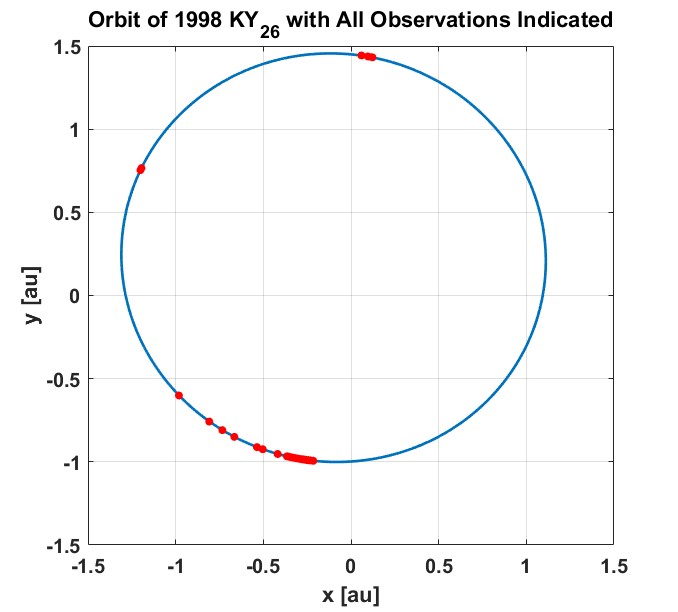
and we immediately see exactly the same clustering of observations (largely in the lower left quadrant) that we did for the other dark comets.
So look at the plot below which is modified from Farnocchia et al:

Now what we find here is the same qualitative evolution of acceleration components (A1, A2, A3) we derived earlier where A1=AR, A2=AT and A3=AN, and furthermore we see that the pink lines (each indicating an observation of 1998 KY26) are clustered around a quadrant where A2 is negative and A3 is also negative - no wonder when Seligman et al did their research for this dark comet they found significant non-zero values of A2 and A3, this was all due to the clustering of observations creating biases in these calculations, as mentioned.
The question now is whether the Phobos 1 probe could possibly also conform to all the requirements listed (1)-(5) above? My contention is that it may well be possible, but we can't tell for sure. The main problem is whether (3), that is an alignment of the spin axis with a principal axis on Phobos 1, could have been achieved by the time of the dark comet's discovery in 1998? I think it is possible but the answer will not be known until the JAXA Hayabusa2 probe arrives at the object in July of 2031.