• Skip to primary navigation
  • Skip to main content
  • Skip to primary sidebar
  • Skip to footer

Initiative for Interstellar Studies

Working towards the achievement of interstellar flight through knowledge to the stars - Starships in our lifetime

  • What we do
    • Education
      • Education
      • ISU Projects
      • Starship Engineer
      • SF Starships
      • STEM & Schools
      • Talk Series
      • Exploring Equations
      • LSI Summer Course
    • Technical
      • Project Dragonfly
      • Andromeda Probe
      • Project Glowworm
      • Project Lyra – Exploring Interstellar Objects
      • von Neumann AI Probe
      • Project World Ship
    • Sustainability
    • Enterprise
    • The Alpha Centauri Prize
    • X-Projects
    • I4IS-USA
    • In the media
  • Who we are
    • About Us
    • Board of Directors
    • Education
    • Researchers
    • Managers
    • Team i4is Gallery
    • Interstellar artists
      • David A Hardy
      • Adrian Mann
      • Alex Storer
      • Terry Regan
    • Contact us
  • Events
  • Publications
    • Principium
    • Axiom
    • Monographs & Reports
    • Books
    • App
    • Team Publications
    • Useful Resources
  • Blog
  • News
  • Members
    • Join Now
    • Login
  • Donate
You are here: Home / Starship Blog / 3I/ATLAS: What would Juno need to do?

3I/ATLAS: What would Juno need to do?

21 August 2025

Adam Hibberd

Having demonstrated yesterday that a reasonably low DeltaV (velocity increment) applied by the Juno's engine could achieve a significantly closer approach to 3I/ATLAS than would otherwise be the case if Juno stayed in its current Jupiter orbit, surely that would be the end of the matter?

The answer is 'not quite', since this was a 'single impulse' scenario and assumed only a one-off application of DeltaV to heave the probe closer to the target. This clearly neglected the possibility of multiple impulses, which could well demand a much smaller overall DeltaV budget though still achieve the same desired goal.

As already explained in my previous blog here, further impulses add significantly to the overall complexity of the problem, and so slows the convergence time of the Non-Linear Problem (NLP) solver, in this case NOMAD. However I determined to investgate the double impulse option using a modified version of the REBOUND software I developed for the single impulse case, and the results were forthcoming after a couple or so days of execution.

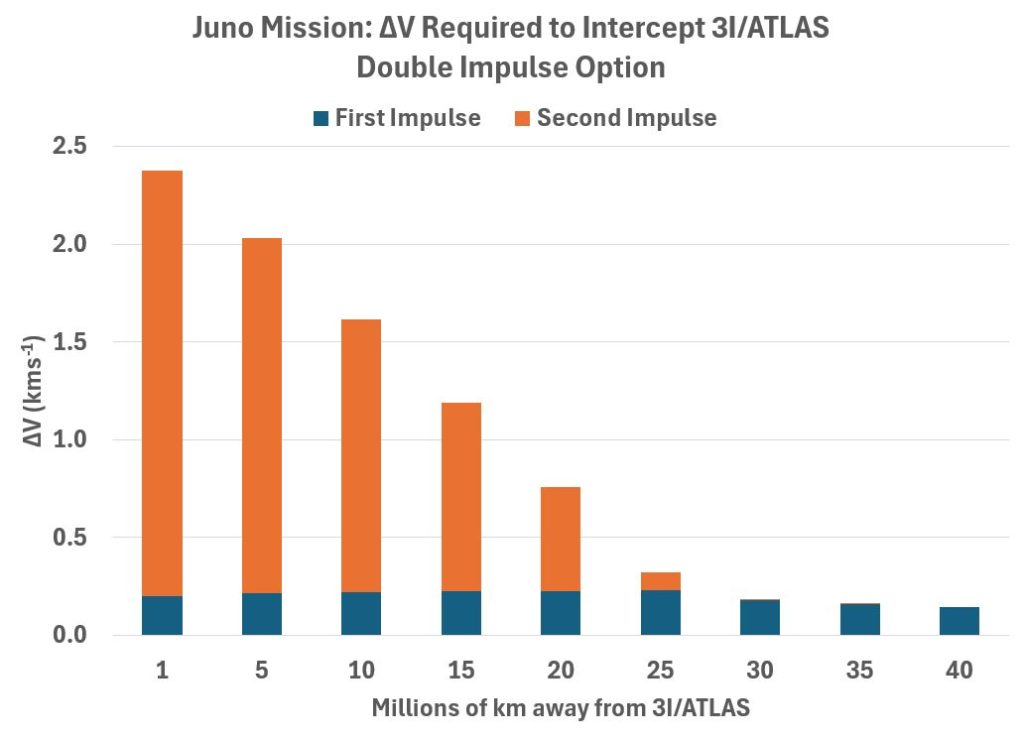
See below for the pertinent plots extracted from the revised paper (which is here btw).
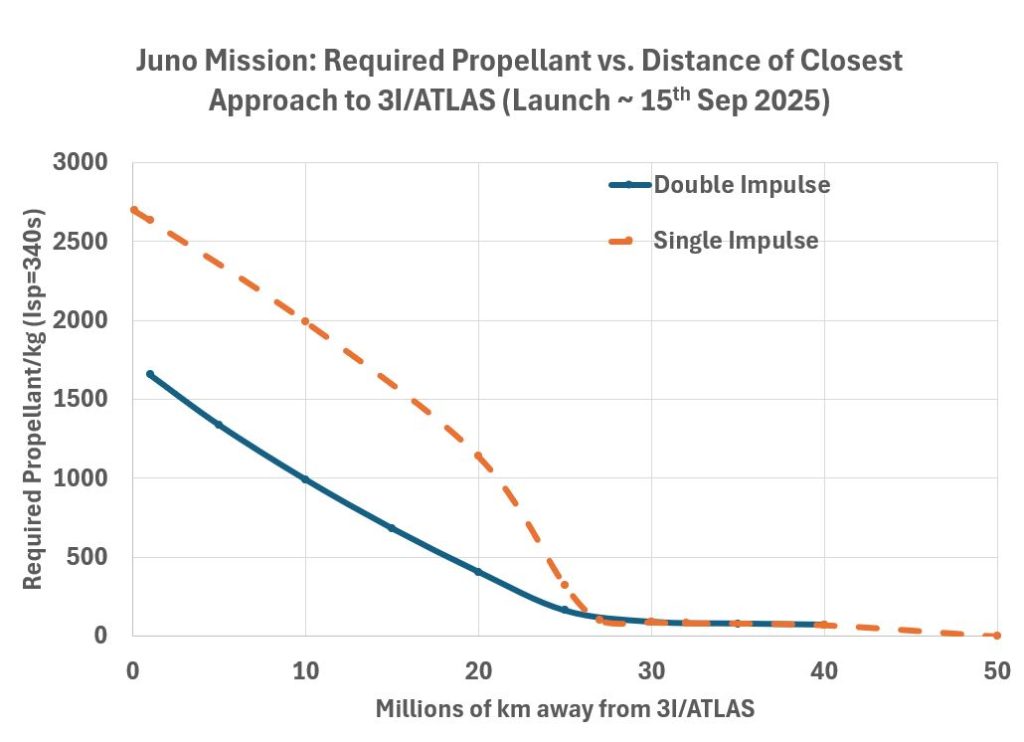
We see from the first plot that for 3I/ATLAS distances of less than say 25 million km, there is a significant saving in required propellant as compared with the single impulse case, with typically 50% less propellant being required.

This incredible finding is offset to some extent by the fact that for distances greater than 25 million km, where very little propellant is needed, the saving from the additional impulse becomes negligble and with reducing DeltaV requirement, the double impulse merges into the single impulse solution, as we see from the second plot above.


Primary Sidebar

Blog

Members Newsletter – August

28 August 2026

Interstellar Symposium: Register Now! The Interstellar Research Group (IRG) is pleased to announce that registration is now open for the 2nd European Interstellar Symposium, taking place December 2 to 4, 2026, in Venice, Italy. This special symposia is hosted by The Venetian Institute of Sciences, Letters and Arts in association with The Interstellar Research Group and […]

How long does it take to get to the Sun/Earth L4 Point from Earth?

18 August 2026

Adam Hibberd Let’s say we eject a spacecraft with a small velocity decrement in the opposite direction to Earth’s own velocity around the Sun, what will happen to it exactly? It will stay around Earth’s heliocentric orbit since its velocity is close to Earth’s, however we shall assume that the spacecraft flies outside of Earth’s […]

What is 1998 KY26?

6 August 2026

Adam Hibberd I was recently referred to a paper by Farnocchia et al which apparently, so was it argued, contradicted the notion that 1998 KY26 could be technogenic (man made), in other words a spacecraft. For the uninitiated, 1998 KY26 has always been considered (up-to-recently at least) a Near Earth Asteroid (NEA) of some form […]

Members Newsletter – July

31 July 2026

News from i4is I4is return to the Royal Institution, London, UKTwo more of our popular workshops “Skateboards to Starships” are returning this summer to the Royal Institution, 21 Albemarle St, London W1S 4BS.24 August 2026 see https://www.rigb.org/whats-on/holiday-workshops-skateboards-starships-year-10-1325 August 2026 see https://www.rigb.org/whats-on/holiday-workshops-skateboards-starships-year-7-9 Europlanet Science Congress 2026The Europlanet Conference takes place in The Hague, The Netherlands from […]

Join i4is for a journey to the stars!

Members get access to exclusive videos. Here's a taster:

Join now

Footer

Contact i4is

Initiative for Interstellar Studies
27/29 South Lambeth Road
London, SW8 1SZ
United Kingdom

info@i4is.org

Starship Blog

Members Newsletter – August

How long does it take to get to the Sun/Earth L4 Point from Earth?

What is 1998 KY26?

Members Newsletter – July

Donate

The Initiative for Interstellar Studies is entirely dependent upon the goodwill of its volunteer teams, the minor amounts we receive from our activities and the sale of our merchandise but also the kindness of donors. In order to advance our mission of achieving interstellar flight over the next century, we need your help and support. If you are feeling generous we would very much appreciate your help in moving our mission forward. Make a donation » about Donate

  • Shop
  • Donate
  • Privacy & Cookies
  • Contact us

Initiative for Interstellar Studies Limited
27-29 South Lambeth Road, London, SW8 1SZ
Company Limited by Guarantee No: 09062458 (England and Wales)
Copyright © Initiative for Interstellar Studies · Built by Jason King

Manage Cookie Consent
To provide the best experiences, we use technologies like cookies to store and/or access device information. Consenting to these technologies will allow us to process data such as browsing behaviour or unique IDs on this site. Not consenting or withdrawing consent, may adversely affect certain features and functions.
Functional Always active
The technical storage or access is strictly necessary for the legitimate purpose of enabling the use of a specific service explicitly requested by the subscriber or user, or for the sole purpose of carrying out the transmission of a communication over an electronic communications network.
Preferences
The technical storage or access is necessary for the legitimate purpose of storing preferences that are not requested by the subscriber or user.
Statistics
The technical storage or access that is used exclusively for statistical purposes. The technical storage or access that is used exclusively for anonymous statistical purposes. Without a subpoena, voluntary compliance on the part of your Internet Service Provider, or additional records from a third party, information stored or retrieved for this purpose alone cannot usually be used to identify you.
Marketing
The technical storage or access is required to create user profiles to send advertising, or to track the user on a website or across several websites for similar marketing purposes.
  • Manage options
  • Manage services
  • Manage {vendor_count} vendors
  • Read more about these purposes
View preferences
  • {title}
  • {title}
  • {title}