Adam Hibberd A spacecraft is travelling on a very hyperbolic orbit w.r.t. an object X (possibly a star) which has gravitational mass, μ, meaning the spacecraft is only slightly deflected from its direction of motion. Our task is to quantify the errors in velocity, both longitudinal and transverse, associated with this encounter compared to simply […]
Starship Blog
With the recent creation of the new i4is website, along with the newer blogs, we have included a selection of previous Starship Blog posts from our archive which we hope you will enjoy browsing. If you would like to write an article and have it appear on our web site, then get in touch with us.
‘Oumuamua: Lasers in Space
Adam Hibberd In my latest research, I have been considering the case of using laser structures in space to accelerate space laser sails to sufficient speed so that they will ultimately reach the first discovered interstellar object, 1I/’Oumuamua, within a matter of years from launch, or even as soon as a year. This is clearly […]
i4is – BBC Sky at Night Feature

Great to see that our research has been featured in the well-known BBC Sky at Night Magazine: “Spacecraft powered by light sails and lasers offer a quicker way to explore the Solar System. But there’s a catch.” Check it out here! Congrats to Manasvi Lingam, Adam Hibberd, and Andreas Hein! (Image credit: BBC)
Astronomy Magazine Cover Feature: Project Lyra

Project Lyra is the cover feature of the bestselling astronomy magazine in the world! Check out the 10-page article of the June 2024 issue of Astronomy with a lot of great artwork based on the work by the Project Lyra team and beautifully executed by Maciej Rebisz. Get a digital copy here or a physical […]
Measurement of Mass by Space Sails
Adam Hibberd I’ve been doing a little algebra. Let me state the problem. Let us say we have a swarm of space sails flying edge on to the interstellar medium (ISM). This swarm lies in a plane at right angles to its velocity relative to this ISM. Now lets bring in an element of the […]
Project Lyra Mission Guide
Adam Hibberd I provide for you a chart of some missions to 1I/’Oumuamua investigated by Project Lyra. The green rows use chemical propulsion, the blue use nuclear thermal propulsion (NTP) and the pink exploit laser sails. This table will be updated when new research becomes available. For more detail, zoom in with your mouse (Ctrl+scroll […]
Swarming Proxima: i4is wins NASA NIAC Grant

In collaboration with Space Initiatives Inc., we have succeeded in securing a prestigious NIAC grant. “Thomas Eubanks, Space Initiatives Inc. in Florida, believes a swarm of tiny spacecraft could travel to Proxima Centauri this century, sending back data about the Sun’s nearest interstellar neighbor using a novel laser sailcraft and laser communications.” More information here.
Project Lyra: A Solar Oberth at 10 Solar Radii

Adam Hibberd I have recently returned my attention to the Solar Oberth mission to ‘Oumuamua. For readers not familiar with this celestial body, 1I/’Oumuamua was the first interstellar object to be discovered passing through our Solar System, is now out of range of our most powerful telescopes and has left scientists with many questions in […]
Swarming Proxima

Adam Hibberd Breakthrough Starshot is the Initative to send a probe at 20% light speed (0.2c) to the nearest neighbouring star Proxima Centauri. But how do we achieve such a high speed? It turns out that if we have an extremely powerful laser (and exponential advances in tech over the next decades will mean that […]
PROJECT HYPERION: THE HOLLOW ASTEROID STARSHIP – DISSEMINATION OF AN IDEA
Andreas M. Hein Asteroid starship arriving at an alien world by David A. Hardy Source: https://www.comicartfans.com/gallerypiece.asp?piece=1618045 A large space mirror heats up an asteroid, slowly melting it. Water, which was injected into the center of the body expands, blows up the melted material, creating the shape of a balloon. After cooling down, rotation is induced […]
Laser and Sail in Earth Orbit with Evolutionary Neurocontrol
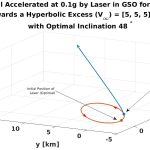
Adam Hibberd In my last post I explained how my software development, Optimum Interplanetary Trajectory Software (OITS), seems to achieve miracles of intelligent design in a fashion analogous to evolution, though in fact with both cases evidently no intelligence is involved – instead simple mechanisms combined with iteration are at work. This concept stimulated me […]
OITS Takes on Evolution

Adam Hibberd The more I think about evolution through natural selection the more I see analogues to my software development Optimum Interplanetary Trajectory Software. (I should make it clear at this early stage in my post that OITS does NOT employ a genetic/evolutionary algorithm approach, I shall elucidate below.) You see there is NO intent […]