Adam Hibberd
Many readers in-the-know will have heard of the future ESA 'Comet Interceptor' mission, due to launch in 2029.
For those not-in-the-know it is a spacecraft desgined to loiter at the famous Sun/Earth Lagrange 2 (L2) point for a few years, waiting for a 'pristine' Oort Cloud comet to come flying in to the inner Solar System and approach close to the Sun. When a suitable target can be identified (probably by the famous Vera C Rubin telescope in Chile), 'suitable' in the sense that it is reachable by the Comet Interceptor (i.e. its ΔV requirement is below a threshold for the spacecraft), then the Interceptor will be dispatched at the proper moment to intercept the comet and study it up close.
All very well and good, but what relevance is this to interstellar travel? Well it seems a secondary target for this spacecraft may be a convenient approaching interstellar object (ISO). But how likely will an interstellar object be reachable by the 'Comet Interceptor' architecture? The answer is quite a reality check and is along the lines of 'not many, if any'! For instance it was discovered that the interstellar object, 3I/ATLAS, would have been infeasible for the CI architecture (at least in it current form and with current ΔV budget which corresponds to 'oomph from the rocket').
Stimulated by a conversation with a US colleague I decided to have a go at finding the chances.
I assumed that the spacecraft would be loitering somewhere along the Earth's heliocentric orbit around the Sun at 1 au from it. This is clearly different from the S/E L2 point which is about 1.5 million km further out from the Sun than the Earth. The reason for this change of orbit was simply that our own proposed mission architecture under investigation demanded it.
The first problem was to model the incoming ISOs which I did with the 'Gaia Catalogue of Nearby Stars', a huge database of stars in the vicinity of the Sun, specifically using their velocities relative to the Sun in Galactocentric coordinates. With this data I could derive the distribution of the so-called 'incoming radiants' of ISOs, and this is shown in the plot below:
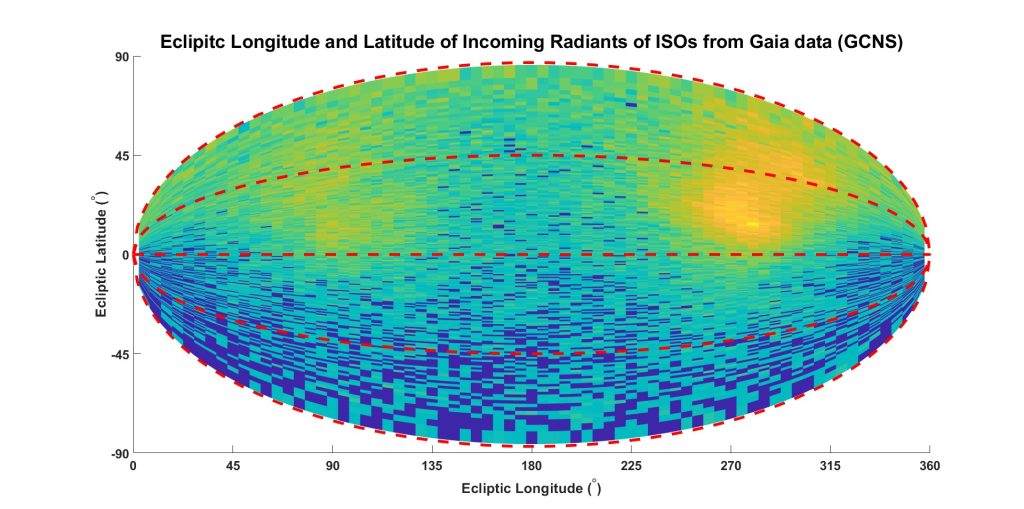
Having computed this distribution, I could then model the orbits of incoming ISOs as required.
My software generated 10,000 ISOs and generated Data D1 and Data D2:
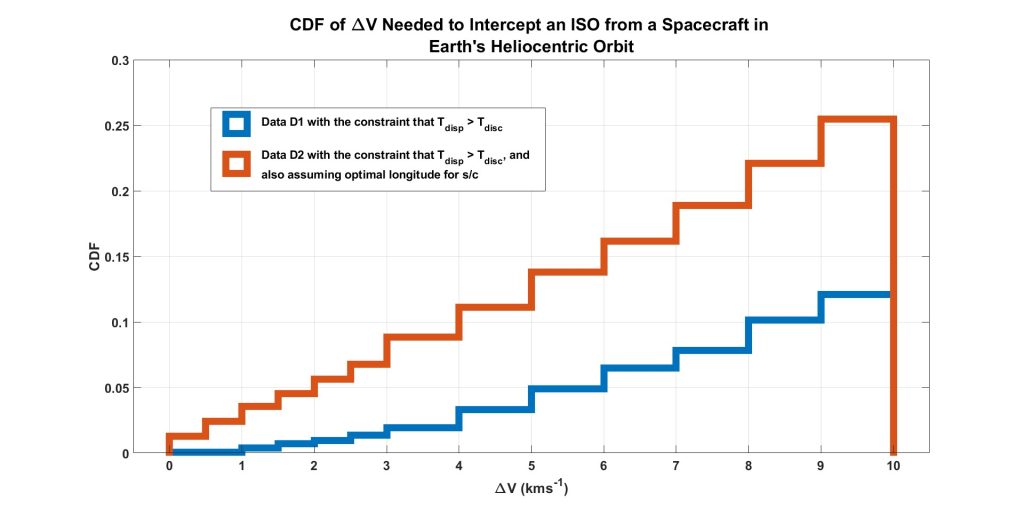
Data D1: The spacecraft is randomly and uniformly distributed in longitude around Earth's heliocentric orbit, what is the probability that the ISOs can be intercepted (blue data in graph below).
Data D2: The ISOs are hurled at the inner Solar System as in D1, but the spacecraft are positioned longitudinally precisely on the optimal longitude to allow the spacecraft to intercept the ISO with minimum ΔV (red data below)
These two datasets are shown in histogram form in the plot below, and perhaps unsurprisingly, the optimally placed probe would be able to reach far more ISOs (the red data), than the randomly placed probes (blue data).
The results don't look great for the CI architecture but the potential for this plan is very good, since if optimally placed with an allowable ΔV budget of < 1 km/s, the probability of interception is ~ 2.5 % compared to ~ 0 % for CI.
The idea then is that if we had sufficient probes orbiting the Sun at 1 au, we could increase the success probability quite significantly.