In the movie “Transcendence”, Dr. Will Caster’s consciousness, played by Johnny Depp, is “uploaded” into a quantum computer. This feat unleashes a cascade of rapidly accelerating technological changes, culminating into a “technological singularity”. It is probably the first time that the technological singularity plays a central role in a Hollywood blockbuster. However, the hypothetical concept of uploading one’s consciousness into a computer, also called “mind uploading” or “whole brain emulation”, has been a topic in science fiction for decades. Seemingly far-fetched, mind uploading might be actually not very far from reality. Recently, the European Union’s Human Brain Project has formulated its objective to simulate the human brain. With an anticipated budget of over one billion Euros, it is the largest project of this kind ever conducted. Although the Human Brain Project’s objective is to simulate the human brain, it has spurred discussions about the prospects of mind uploading. Mind uploading might have truly transformative consequences for our civilization. Among them are the potential for digital immortality and the creation of emulated minds which might transform knowledge work, as they can be copied and used on-demand for intellectually demanding tasks (Hanson, 2008a & 2008b).
Mind uploading also opens up exciting opportunities for interstellar flight.
In this article, I will try to give a brief overview of existing concepts for using mind uploading for interstellar travel, as well as proposing novel concepts, which might radically change the way humans would travel to the stars. Furthermore, potential mission architectures are presented, having profound consequences on the way such a mission accomplishes its objectives.
First of all, I clarify what is meant by “mind uploading” in this article. “Mind uploading” is understood here as the transfer of mental content, for example long term memory, or consciousness, from the brain substrate into an artificial device, a digital, analog, or quantum artificial neural network (Sandberg & Bostrom, 2008). Once uploaded, the mental content can be “run” on the device as a simulation or simply stored. Analogously, “mind downloading” is defined as the transfer of mental content from an artificial device to brain substrate. Mind downloading goes hand in hand with the recreation of the human body in its entirety. Otherwise, mind downloading would not make a lot of sense for interstellar travel. If the whole body is up- and downloaded, this can be termed “human uploading” or “whole body emulation”. In this article, the boundaries between “mind uploading” and “human uploading” are often blurred. They are therefore considered to be exchangeable.
The main objective of manned interstellar travel is transporting humans to another star system and starting a new civilization there. The basic idea of using mind uploading for interstellar travel is to upload the human mind and/or body and to recreate it at the target destination. To jump-start a new, thriving civilization at the target destination requires the transfer of knowledge for performing all necessary activities. Transporting humans in digital form has huge benefits for interstellar travel: Firstly, it leads to extreme mass savings. No longer are large habitats and complex life-supporting systems needed. At the same time it offers the capability to “resurrect” living humans at the target destination, including their knowledge and thus culture, thus greatly facilitating the start of a new civilization. Knowledge and technology is transferred from the emulated brains at the target destination, either by education or “hard-wiring” emulations into biological brains.
Of course, one could speculate about the radical possibility of the complete replacement of biological life by artificial life. In this scenario, the spacecraft would be rather the “seed” for a non-biological civilization (Kurzweil, 2005).
Interstellar colonization concepts based on mind uploading can be categorized as shown in Table 1.
Table 1: Colonization tasks mapped to interstellar colonization concepts based on mind uploading
| Function | Concept 1 | Concept 2 | Concept 3 | Concept 4 | Concept 5 |
|---|---|---|---|---|---|
| Transport Humans | Hardware static storage | Brain emulations | Hybrid: genetic material + emulations | Electromagnetic waves | Transmit electromagnetic waves / nano spacecraft via wormholes |
| Construct colony | Macroscopic replicators | Micro / nano replicators | |||
| Establish civilization | Emulations + biological humans | Cyborgs | Emulations + biological humans | Emulation cities (Hanson, 2008a, 2008b) | Matrioshka brain (Bradbury, 2001) |
In order to transport humans as emulations, they need to be uploaded. Uploading might be accomplished by some advanced form of scanning. Hans Moravec was one of the first to envision a form of brain scanning, by which the human brain would be incrementally uploaded in a destructive way (Moravec, 1988). Kurzweil and others envisioned non-destructive ways of uploading, for example by using nano-scale robots that scan the brain from within (Kurzweil, 2005, p.145).
Creating a copy of the brain is a daunting task. It is far more than copying just the structure of the brain, but also the structure of individual neurons and their linkages to other neurons. What is further needed is to copy the behavior of individual neurons and larger structures in the brain. This is similar to a technical system. The understanding of how the parts of a car are related to each other does not prescribe how they work together to perform the desired function of transporting passengers. It can only be inferred by painstakingly assessing how individual components and larger groups of components perform subfunctions. These subfunctions together perform the top-level function. This reverse engineering method is called a bottom-up approach. As an alternative, one can analyze functions top-down, by first decomposing the top-level functions into subfunctions. Similar reverse engineering approaches were proposed for creating brain emulations (Sandberg & Bostrom, 2008).
After an emulation has been created, it could be switched, copied, run, and also switched off as desired (Hanson, 2008a & 2008b). For an interstellar mission, emulations could be stored and first activated at the target destination. This would save energy for running emulations during flight. Having arrived at the target destination, one can imagine how activated emulations first assess the environment within the target star system and determine the best strategy for beginning colonization. Maybe a whole population of emulations is activated, which debates possible strategies and analyzes their potential outcomes. Robin Hanson imagines various types of emulations which also form hierarchies, depending on their simulation speed. Such emulation cities on Earth would consume a huge amount of power to sustain the emulations and their virtual environment in which they exist. Manipulations of the physical world are performed by various types of manipulators and robots (Hanson, 2008a & 2008b). A strategy for an interstellar mission would be the reactivation of an initial small population of emulations which make the initial decisions of how to proceed with colonization. Then, resources would be mined and processed, in order to increase computational capability and to create a larger number of emulations, which then create biological humans along with their habitats. Another option is the simultaneous transportation of zygotes and emulations.
A more advanced version of such a mission is the initial creation of an infrastructure within the target star system by using replicators and the construction of a receiver for electromagnetic signals, for example a laser beam. Once established, data for objects could be transmitted with light speed. This is the concept of teleportation. Teleportation was often deemed infeasible, as the amount of information to be transmitted for assembling a human body molecule by molecule would be prohibitive. For example, Roberts et al. argue that a total of 2.6*1042 bits are necessary for recreating the human brain (Roberts et al., 2012). The data for recreating the rest of the human body is insignificant compared to that number (1.2*1010 bits). With a data rate of about 3.0*1019 bits per second, it would take 4.85 trillion years to transmit a human. However, a close look into the assumptions made in the paper reveals that the so-called Bekenstein bound was used for calculating the data required to recreate the brain (Bekenstein, 73), (Lokhorst, 00). The Bekenstein bound describes the maximum information that is required to recreate a physical system down to the quantum level. It is doubtful that such an extremely detailed description is necessary. Current estimates for describing the brain down to a molecular level are rather in the range between 1022 – 1027 bits (Sandberg, 2008, p.80). This amount of data could be transmitted within an hour to ten years, assuming the same data rate of 3,0*1019 bits per second. Thus, teleportation might not be as far-off as suggested by the current literature. A mission architecture based on teleportation is shown in Figure 3.
One of the more speculative approaches to enable manned interstellar travel with almost no travel time is to use some form of faster-than-light approach. There is a whole plethora of conjectured faster-than light approaches (Davis et al., 2009). Sending pure data or nano probes through shortcuts in space-time is far easier than doing so with large manned spacecraft. Kurzweil speculates how microscopic wormholes might enable the transmission of data or nano probes to another place in the Universe (Kurzweil, 2005, p.354-355). A mission architecture based on this concept is shown in Figure 4.
Mission architectures
Digital interstellar missions open up a space of interesting mission architectures. Depending on the available technologies, various architectures are feasible, as shown in Table 2.
Table 2: Digital mission architectures and their enabling technologies
| Technologies | A | B | C | D |
|---|---|---|---|---|
| Replicator technical systems | required | required | required | required |
| Replicator / Grow biological systems | required | required | required | required |
| Brain emulation | required | required | required | required |
| Teleportation | required | required | ||
| Wormholes | required |
Architectures A to D can be seen in the figures below, along with their mission sequence.
Architecture A
- Send replicator + emulator / storage spacecraft
- Create colony and resurrection infrastructure
- Create population
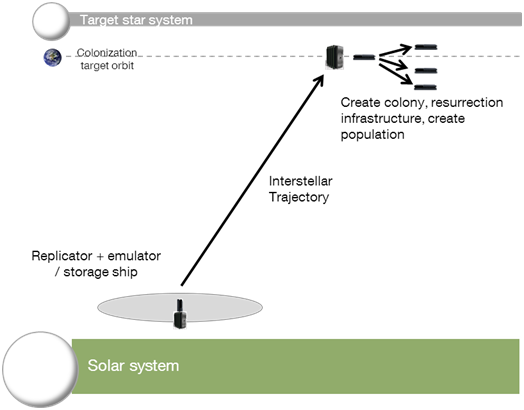
This is the simplest mission architecture for an emulation interstellar mission. The spacecraft consists of the emulator payload and a replicator payload which bootstraps local resources to manufacture the initial space colony. The emulations are subsequently downloaded and human bodies are created.
Architecture B
- Send replicator
- Create colony and resurrection infrastructure
- Send emulator / storage spacecraft
- Create population
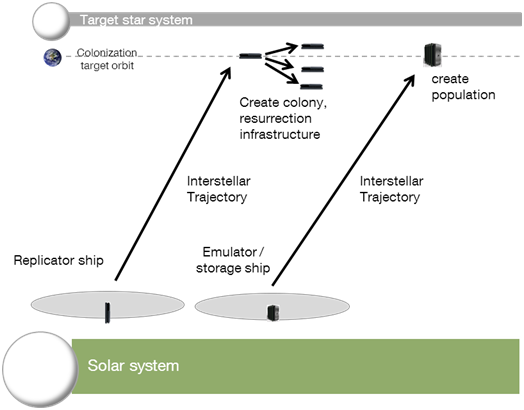
Architecture B is based on two spacecraft. The replicator spacecraft is launched first, in order to initiate colony construction way before the emulator spacecraft arrives. This architecture makes sense if colony construction takes decades or centuries. The main advantage is the reduction of risk from a failure to construct the initial colony. The emulator spacecraft could be launched only if the colony is operational. Another advantage is the use of a different propulsion system for the emulator ship, allowing for a shorter trip duration than the replicator ship. A shorter trip duration reduces the risk of failures of on-board systems, which is more critical for the emulator ship as it has in principle a human payload on-board.
Architecture C
- Send replicator spacecraft
- Create receiver dishes in target star system
- Receive data for creating technical systems & humans
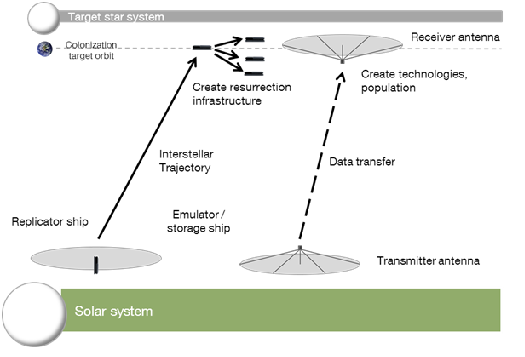
In order to teleport data, a receiver has to be constructed within the target star system first. This is done by the replicator spacecraft’s payload. Apart from the receiver, a molecular assembly facility or universal 3D-printer has to be constructed, which then recreates the original objects. The main advantage of this architecture is the travel duration for the objects transferred, as the data is transmitted is the speed of light.
Architecture D
- Send replicator spacecraft
- Build receiver
- Use wormholes to transmit information to receiver
- Create technological systems & humans
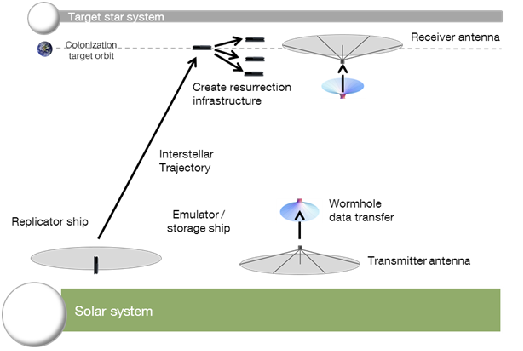
After the construction of a receiver and molecular assembly facility, data is transferred almost instantly through a worm hole or other exotic means.
Conclusions
The concept of brain emulation is often associated with the occurrence of the so-called technological singularity, which is often associated with the emergence of general artificial intelligence and its exponentially increasing capabilities. Whether or not it is reasonable to expect such a singularity to happen is the matter of intense debate among scholars (Sandberg, 2010), (Sandberg & Bostrom, 2011), (Goertzel, 2007). Personal conversations with a range of brain researchers have rather revealed a skeptical outlook on progress in creating brain emulations in the near future. Nevertheless, there is no doubt that progress is being made. Brain emulation and general artificial intelligence should not be discarded on the grounds of current or near-future infeasibility, as we are dealing with timeframes of decades to centuries until interstellar missions are conducted.
As a final remark, Launius & McCurdy point out that a posthuman civilization does not necessarily possess the motivation to conduct an interstellar mission (Launius & McCurdy, 2008, pp.218-219). Thus, one has to keep in mind that changing the human condition so profoundly will certainly have consequences for its behavior as well.
Although the prospects of mind uploading are controversial, its realization within the 21st century should not be deemed infeasible. It is even imperative to think about possible implications of this technology, as its realization would drastically change our civilization as well as it would revolutionize interstellar travel. How would it then feel to travel to the stars? After being scanned, would we suddenly wake up in a new body on an exoplanet? Would we instead pass our time in a virtual world crossing the space between the stars, finally transforming into a biological existence again? Fascinating but also somewhat chilling thoughts…

by Andreas Hein
References
Bekenstein, J. D. (1973). Black holes and entropy. Physical Review D, 7(8), 2333.
Davis, E. W., & Millis, M. G. (2009). Frontiers of propulsion science. American Institute of Aeronautics and Astronautics.
Goertzel, B. (2007). Human-level artificial general intelligence and the possibility of a technological singularity: A reaction to Ray Kurzweil’s The Singularity Is Near, and McDermott’s critique of Kurzweil. Artificial Intelligence, 171(18), 1161-1173.
Hanson, R. (2001). Economic growth given machine intelligence. Journal of Artificial Intelligence Research.
Hanson, R. (2008a). Economics of brain emulations. In Tomorrow’s people – proceedings of the james martin institute’s first world forum: EarthScan.
Hanson, R. (2008b). Economics of the singularity. Spectrum, IEEE, 45(6), 45-50.
Kurzweil, R. (2005). The Singularity Is Near: When Humans Transcend Biology, Penguin Books.
Launius, R. D. (2008). Robots in space: technology, evolution, and interplanetary travel. JHU Press.
Lokhorst, G. J. (2000, May). Why I am not a super-Turing machine. InHypercomputation Workshop, University College, London (Vol. 24).
Moravec, H. (1988). Mind children. Cambridge, MA: Harvard University Press.
Sandberg, A., & Bostrom, N. (2008). Whole brain emulation: A roadmap. Future of Humanity Institute, Oxford University. Available at: http://www.fhi.ox.ac.uk/brain-emulation-roadmap-report.pdf Accessed July, 3, 2010.
Sandberg, A. (2010). An overview of models of technological singularity. In Roadmaps to AGI and the future of AGI workshop, Lugano, Switzerland, Mar. 8th.
Sandberg, A., & Bostrom, N. (2011). Machine intelligence survey. Technical Report, 2011-1. Future of Humanity Institute, University of Oxford. www.fhi.ox.ac.uk/reports/2011-1. pdf.