• Skip to primary navigation
  • Skip to main content
  • Skip to primary sidebar
  • Skip to footer

Initiative for Interstellar Studies

Working towards the achievement of interstellar flight through knowledge to the stars - Starships in our lifetime

  • What we do
    • Education
      • Education
      • ISU Projects
      • Starship Engineer
      • SF Starships
      • STEM & Schools
      • Talk Series
      • Exploring Equations
      • LSI Summer Course
    • Technical
      • Project Dragonfly
      • Andromeda Probe
      • Project Glowworm
      • Project Lyra – Exploring Interstellar Objects
      • von Neumann AI Probe
      • Project World Ship
    • Sustainability
    • Enterprise
    • The Alpha Centauri Prize
    • X-Projects
    • I4IS-USA
    • In the media
  • Who we are
    • About Us
    • Board of Directors
    • Education
    • Researchers
    • Managers
    • Team i4is Gallery
    • Interstellar artists
      • David A Hardy
      • Adrian Mann
      • Alex Storer
      • Terry Regan
    • Contact us
  • Events
  • Publications
    • Principium
    • Axiom
    • Monographs & Reports
    • Books
    • App
    • Team Publications
    • Useful Resources
  • Blog
  • News
  • Members
    • Join Now
    • Login
  • Donate
You are here: Home / Starship Blog / What’s up with 1998 KY26?

What’s up with 1998 KY26?

1 June 2026

Adam Hibberd

I'm not sure whether you might already be aware of this but there are really weird objects orbiting the Sun which astronomers have observed and tried to categorize as a new class of object, 'the dark comets'.

But what makes them weird? It's the rather strange fact that the peculiar orbital paths they follow indicate that these objects are under the influence of mysterious forces. In fact they can ONLY really be explained by the presence of mysterious forces.

Let's look at the one designated 1998 KY26 for instance. The ONLY scientific inferences we can draw from this object can be from its observations. For this object there are at least 230 observations, just about all of which comprise a pair of angles (right ascension and declination), some including an 'apparent brightness' but ALL of which have an all-important time-stamp.

It is from these observations that its orbital path against time can be derived, and for any time instant, we can say that ALL these observations combine to enable us to calculate a single 'state vector' (position and velocity), in fact a best estimate of position and velocity at that time.

However there is also uncertainty in these observations and so the derived state vector will have a spread or blob of possible state vectors around this best estimate, whose structure is characterized by a 6x6 matrix called the 'covariance matrix', more on this later.

Let's look at the brightness evolution of 1998 KY26 right after its discovery.
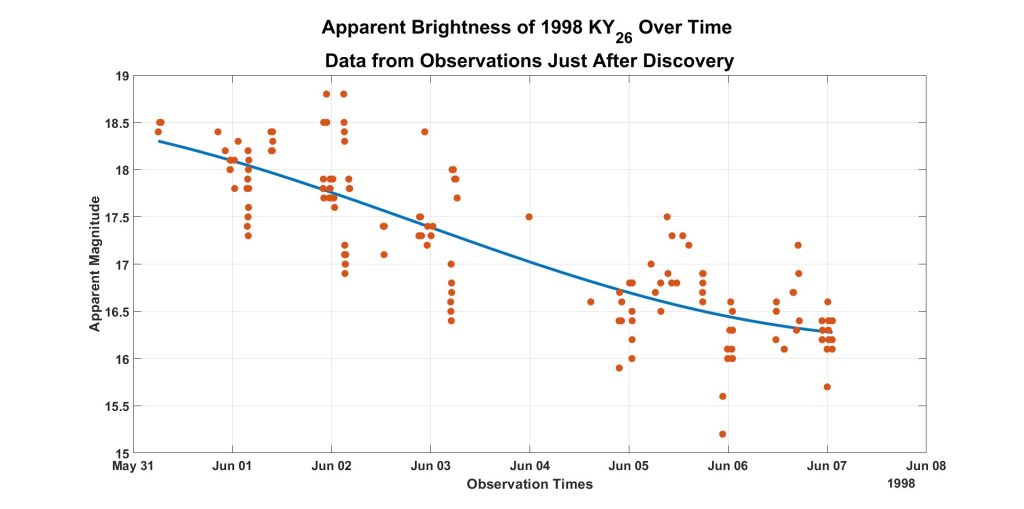
Those red blobs are apparent magnitudes and they are varying wildly by 2 orders of magnitude. This fact in itself is suggestive of a rapidly spinning highly elongated object, what on Earth could this strange object be?

Well let's cast our mind back to 1988 and the launch by Russia within a few days of each other of two missions to Mars, Phobos 1 and Phobos 2. These incredible spacecraft are the largest spacecraft ever to travel through interplanetary space. It so happens that Phobos 1 was lost a couple of months after launch due to an upload of a faulty command from Ground Control.

Could this 1998 KY26 actually be the Phobos 1 probe? There is compelling evidence FOR this hypothesis, but there is always doubt about assertions like this - are the coincidences merely flukes?

  1. Phobos 1 probe is 11 metres in diameter and so is 1998 KY26
  2. 1998 KY26 is highly reflective and so would have been Phobos 1
  3. The evolution of apparent magnitude fits (see above)
  4. There is a pathway between them which is energetically coherent with Phobos 1

Let us talk now about number (4) above.

There is some contemporaneous evidence from the newsletter of the European Southern Observatory (ESO) which is EXTREMELY important at this stage. In 1988, only 2 weeks after the probe had been lost due to bugs in its code, Russia asked ESO to attempt to observe Phobos 1. On 1988 SEP 22, despite the observatory pointing at the expected location, the telescope could not pick out the probe. This suggested that, as mentioned in the newsletter, the spacecraft had unexpectedly applied thrust sometime before attempted observation and after the spacecraft's initial failure.

I decided to apply TWO DeltaVs to the probe to see whether this could enable the probe to 'morph' into 1998 KY26, at least astrodynamically speaking. I found it could, and with a low discrepancy from the uncertainty blob I mentioned above, in fact a low 'Mahalanobis distance'. This distance is precisely a measure of the statistical deviation of the two objects as a function of the standard deviations in each of the 6D position and velocity components (characterized by the previously mentioned covariance matrix).

Encouragingly the first DeltaV was optimally positioned right after loss of the probe - 1988 SEP 02 - explaining the non-observation by ESO. The second one would need to be way after this in 1996 MAY, in order for the two objects to match phase and orbit with an arbitrarily small Mahalanobis distance. This second DeltaV happened around aphelion (furthest distance from the Sun), suggesting that the 'zombie' spacecraft may have thought it was approaching Mars and so decided it needed to ignite its rockets for Mars Orbital Insertion (MOI). The huge mass of the Phobos 1 probe meant that it needed a very powerful rocket capable of HUGE momentum change just to achieve MOI successfully.

Now, when one sums the two optimally derived DeltaVs mentioned above, one gets a value of 1.9 km/s and it turns out this is JUST achievable by the rockets for MOI possessed by the Phobos 1 probe. It seems therefore that the two orbits (Phobos 1 and 1998 KY26) are energetically close enough to allow the Phobos 1 probe to become 1998 KY26 - indicating that they could well be one-and-the-same object.

Go to my preprint written by me, Adam Crowl, Carlos Gomez de Olea Ballester and Avi Loeb, here. It will be out on arXiv very soon.


Primary Sidebar

Blog

Mission to an Interstellar Object

5 May 2026

Adam Hibberd Many readers in-the-know will have heard of the future ESA ‘Comet Interceptor’ mission, due to launch in 2029. For those not-in-the-know it is a spacecraft desgined to loiter at the famous Sun/Earth Lagrange 2 (L2) point for a few years, waiting for a ‘pristine’ Oort Cloud comet to come flying in to the […]

Members Newsletter – April

30 April 2026

Dami Lee on Project HyperionWe were really happy to see that our Project Hyperion competition (https://www.projecthyperion.org/) captured the imagination of the architect and Youtuber Dami Lee, who posted a detailed and thoughtful video commentary ‘Can Humans REALLY Leave Earth?’ Over one million views! Check it out: https://m.youtube.com/watch?v=BBb2gC0lByk&pp=0gcJCVACo7VqN5tD(You may want to skip the ads that are […]

Members Newsletter – March

31 March 2026

News from i4isThe i4is Educational team are currently recruiting! If any of our members are interested, and especially if you are in striking distance of London or Lincoln, both in the UK, we could do with support at the April events mentioned below. You can read about some of the activities in recent issues of […]

Principium 52

2 March 2026

Principium 52 has gone out to subscribers and is now accessible to all

Join i4is for a journey to the stars!

Members get access to exclusive videos. Here's a taster:

Join now

Footer

Contact i4is

Initiative for Interstellar Studies
27/29 South Lambeth Road
London, SW8 1SZ
United Kingdom

info@i4is.org

Starship Blog

What’s up with 1998 KY26?

Mission to an Interstellar Object

Members Newsletter – April

Members Newsletter – March

Donate

The Initiative for Interstellar Studies is entirely dependent upon the goodwill of its volunteer teams, the minor amounts we receive from our activities and the sale of our merchandise but also the kindness of donors. In order to advance our mission of achieving interstellar flight over the next century, we need your help and support. If you are feeling generous we would very much appreciate your help in moving our mission forward. Make a donation » about Donate

  • Shop
  • Donate
  • Privacy & Cookies
  • Contact us

Initiative for Interstellar Studies Limited
27-29 South Lambeth Road, London, SW8 1SZ
Company Limited by Guarantee No: 09062458 (England and Wales)
Copyright © Initiative for Interstellar Studies · Built by Jason King

Manage Cookie Consent
To provide the best experiences, we use technologies like cookies to store and/or access device information. Consenting to these technologies will allow us to process data such as browsing behaviour or unique IDs on this site. Not consenting or withdrawing consent, may adversely affect certain features and functions.
Functional Always active
The technical storage or access is strictly necessary for the legitimate purpose of enabling the use of a specific service explicitly requested by the subscriber or user, or for the sole purpose of carrying out the transmission of a communication over an electronic communications network.
Preferences
The technical storage or access is necessary for the legitimate purpose of storing preferences that are not requested by the subscriber or user.
Statistics
The technical storage or access that is used exclusively for statistical purposes. The technical storage or access that is used exclusively for anonymous statistical purposes. Without a subpoena, voluntary compliance on the part of your Internet Service Provider, or additional records from a third party, information stored or retrieved for this purpose alone cannot usually be used to identify you.
Marketing
The technical storage or access is required to create user profiles to send advertising, or to track the user on a website or across several websites for similar marketing purposes.
  • Manage options
  • Manage services
  • Manage {vendor_count} vendors
  • Read more about these purposes
View preferences
  • {title}
  • {title}
  • {title}