Adam Hibberd
I have a preprint out on the feasibility of the hypothesis that 1998 KY26 is actually the Phobos 1 probe, go here.
I have already conducted extensive research into this possibility. Essentially, apart from physical similarities, the argument can be condensed into two important findings:
(1) Two ΔVs caused by thrust from the Phobos 1 probe's engines delivered at two critical epochs can completely account for the differences between the nominal Phobos 1 heliocentric orbit and the known 1998 KY26 orbit, and they would be of a total magnitude within the probe's known propulsive envelope.
(2) Clustering of observations of 1998 KY26 in its orbit, combined with a fixed attitude of 1998 KY26 due to its rapid spin about a principal axis, could explain the observed nongravitational accelerations (NGAs) as caused by sampling bias and would point to a regular shape for 1998 KY26, such as the spinning Phobos 1 probe.
I refer you to my previous two blogs, here and here.
I am pleased to announce I now have further supportive evidence gleaned by analysing the same light curves studied by Santana-Ros et al.
These light curves are distributed across apparitions of 1998 KY26 shortly after discovery in 1998 and again in 2024. They are the same light curves which enabled Santana-Ros et al to accurately determine the rotational time period of 1998 KY26 as (5.3516 ± 0.0001) minutes, which in turn impacted on the interpretation of radar Doppler measurements bringing the best estimate diameter down to (11 ± 2) m.
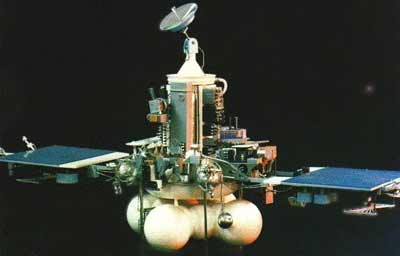
I decided to analyse these light curves to ascertain whether they could be reproduced by an approximation of the Phobos 1 spacecraft rapidly spinning about its principal axis (see the Figure for a photo of the probe). I was aided in my research by AI (ChatGPT).
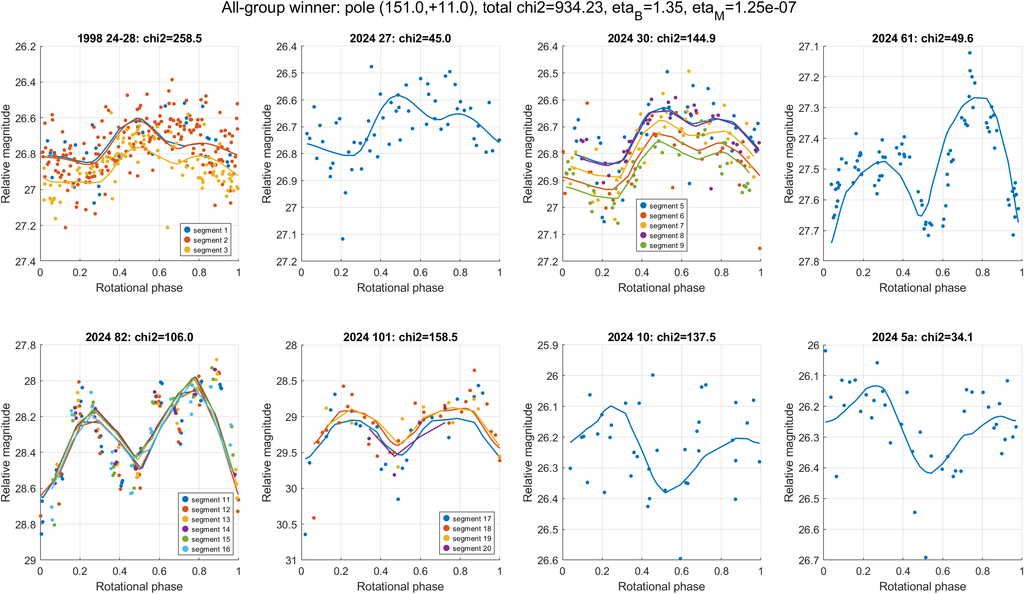
Having conducted this research, the partially surprising find was that yes it could, to within a reasonable uncertainty. However, the even MORE surprising discovery was that when parameters pertaining to the physical appearance of Phobos 1 probe were allowed to be optimized by the software in the sense of minimizing the χ2 of the fitted light curves against the measured light curves; on the whole, they tended to converge to the known values of Phobos 1, or at least to within the precision I could establish from the photos of the probe.
The main unknown was the so-called 'pole' of the spinning object, in other words the orientation of the axis about which the object is rotating. As a reminder, an axis in 3D space can be completely defined by only two angles - in this case in the inertially-fixed ecliptic J2000 reference frame - here denoted (𝜆, 𝛽). This reference frame was also used by Santana-Ros et al and Farnocchia et al, with the former determining (𝜆, 𝛽) = (36°, -44°). Farnocchia et al then adopted this pole and researched the possibility the shape could be an oblate spheroid with a positive result as far as the fit against astrometric observations was concerned.
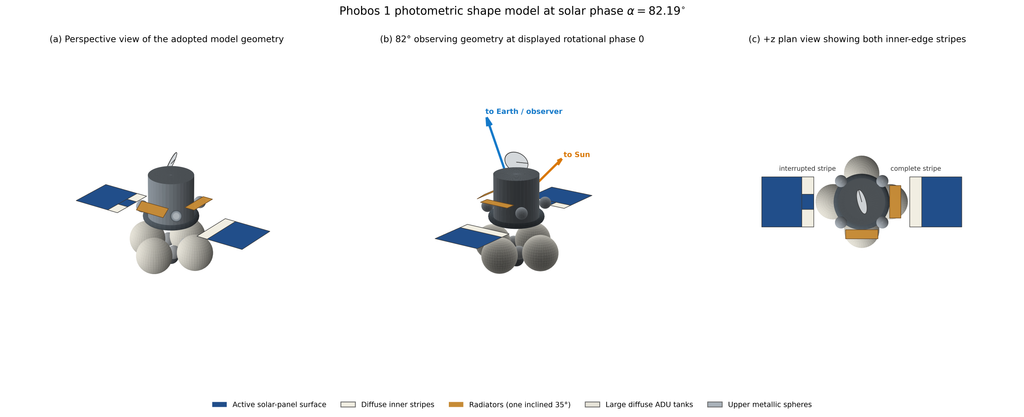
My initial investigation was photometric. Thus, I set about performing a coarse raster scan of (𝜆, 𝛽) against the entire sky of possible values, each time optimizing the candidate spacecraft, so that various design-parameters created as close a match as possible to the 8 light curve groups. I then proceeded with a medium resolution scan around the lead candidates, and then finally a fine scan around the remaining solutions. The eventual spacecraft is shown in the Figure below.
If you examine the light curves, provided below, you can see a close similarity between the patterns in the observed brightnesses (the dots) and the fitted (the solid lines).
I then decided upon a different tack and examined the astrometric data of 1998 KY26, with 260 separate observation points altogether. I wanted to ascertain whether I could produce a better fit to these measurements by assuming that there were additional nongravitational forces on this object, caused by flat surfaces (as would be expected of solar panels) being pushed radially by solar radiation pressure (SRP)1. Since these panels would most likely also be inclined at an angle to the Sun-radius vector, some degree of normal and transverse accelerations might be expected also.
For 1998 KY26, which was found to have an extremely significant normal-to-orbital-plane acceleration by Seligman et al, this normal force was hard to explain by any mechanism other than shedding of gas or dust through the well-known 'rocket-effect', though no such outgassing has ever been observed from 1998 KY26. However the investigation by Farnocchia et al showed that these transverse and orbit-normal forces could be effectively reproduced by SRP and Yarkovsky2 acting on an idealized oblate-spheroid spinning about its principal axis whose pole was determined by Santana-Ros et al through the photometry alluded to above.
When I conducted my investigation assuming SRP on solar panels with fixed inertial orientation, there was a reduction in the root-mean-square (RMS) residual of the fit by 11% compared to the case with no such NGAs modelled. In other words the solar panel assumption was statistically justified. Furthermore the nature of the equations adopted for this solar panel model meant they were still relevant for a pair of panels rotating about their common normal axis, as was assumed in the photometric analysis above. All this, without even modelling the Yarkovsky acceleration, as was required for Farnocchia et al's oblate-spheroid case.
Anyway, to summarise, all this adds further weight to the notion that 1998 KY26 is Phobos 1. However, yet again, I must remind you that the JAXA spacecraft Hayabusa2# will be heading its way towards the object to rendezvous with it in July 2031. Let's wait until then before jumping to any rash conclusions.
- Solar Radiation Pressure (SRP) is the pressure due to momentum transfer of photons arriving from the Sun and impacting on the surface presented by an object, for instance a spacecraft or asteroid. This can cause a 'nongravitational acceleration' on the object ↩︎
- The Yarkovsky force is due to the lag between solar photons impacting on an object's surface and then being radiated out again some time later. It makes itself known by a 'nongravitational acceleration' and requires the object to be spinning, so that this thermal ejection is not entirely radial but has a transverse or normal-to-orbit component. ↩︎