• Skip to primary navigation
  • Skip to main content
  • Skip to primary sidebar
  • Skip to footer

Initiative for Interstellar Studies

Working towards the achievement of interstellar flight through knowledge to the stars - Starships in our lifetime

  • What we do
    • Education
      • Education
      • ISU Projects
      • Starship Engineer
      • SF Starships
      • STEM & Schools
      • Talk Series
      • Exploring Equations
      • LSI Summer Course
    • Technical
      • Project Dragonfly
      • Andromeda Probe
      • Project Glowworm
      • Project Lyra – Exploring Interstellar Objects
      • von Neumann AI Probe
      • Project World Ship
    • Sustainability
    • Enterprise
    • The Alpha Centauri Prize
    • X-Projects
    • I4IS-USA
    • In the media
  • Who we are
    • About Us
    • Board of Directors
    • Education
    • Researchers
    • Managers
    • Team i4is Gallery
    • Interstellar artists
      • David A Hardy
      • Adrian Mann
      • Alex Storer
      • Terry Regan
    • Contact us
  • Events
  • Publications
    • Principium
    • Axiom
    • Monographs & Reports
    • Books
    • App
    • Team Publications
    • Useful Resources
  • Blog
  • News
  • Members
    • Join Now
    • Login
  • Donate
You are here: Home / Starship Blog / How long does it take to get to the Sun/Earth L4 Point from Earth?

How long does it take to get to the Sun/Earth L4 Point from Earth?

18 August 2026

Adam Hibberd

Let’s say we eject a spacecraft with a small velocity decrement in the opposite direction to Earth’s own velocity around the Sun, what will happen to it exactly? It will stay around Earth’s heliocentric orbit since its velocity is close to Earth’s, however we shall assume that the spacecraft flies outside of Earth’s theoretical gravitational sphere of Influence (SoI) and also that it is only affected by the Sun’s gravitational field.

Well the first thing to observe is that the body will gradually drift IN ADVANCE of Earth’s orbit around the Sun. That may seem counter-intuitive but look at it this way. By having a lower velocity relative to the Sun than Earth, that means it will reach a perihelion (closest point to the Sun) slightly lower than Earth’s circular orbit and so the time period, TC of the craft will be shorter than the time period of Earth’s orbit, TE (1 year). Since the time-period of the spacecraft’s orbit is shorter, then that means it will gradually get ahead of Earth. The reasoning is that for every 1 period the spacecraft takes, the Earth will be slightly behind it since its period is longer.

So let’s assume that the time period of the spacecraft is indeed lower than that of Earth’s and allow the spacecraft to creep ahead of Earth until it reaches the so-called Sun/Earth L4 point. For the uninitiated, that sits at exactly 60° (π/3 radians) in advance of the Earth along Earth’s orbit around the Sun. How long would that take exactly?

The answer to this turns out to depend on the velocity with which the object leaves the Earth’s SoI, which we shall equate here to the object’s hyperbolic excess speed relative to Earth.

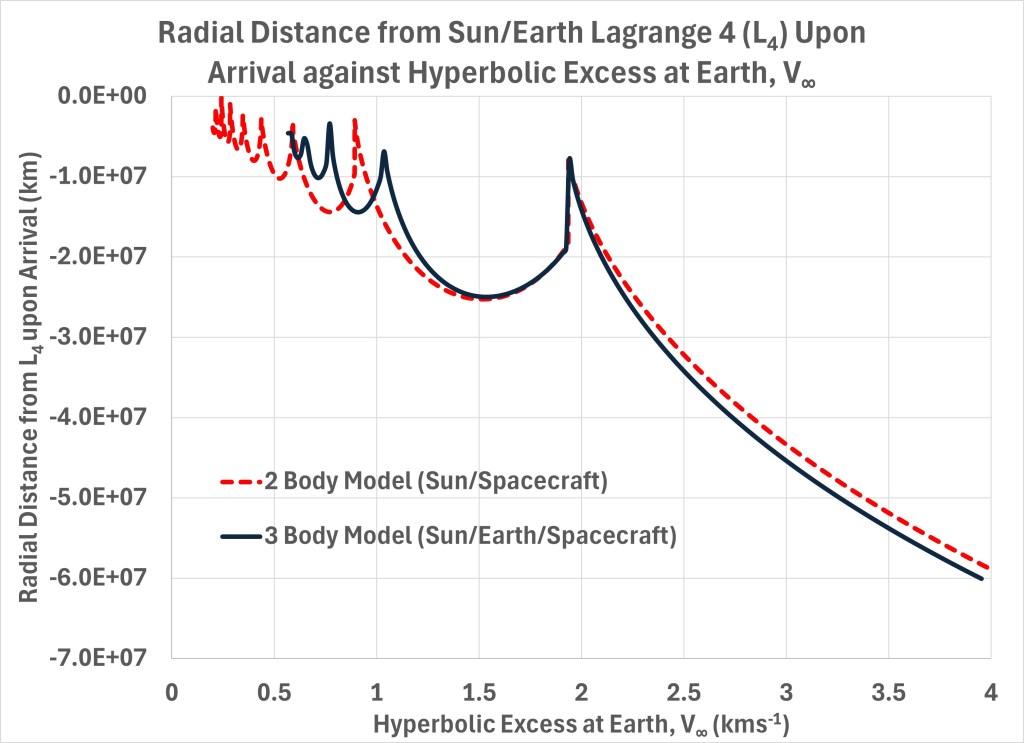
I have done precisely this research and I generated the following two plots.
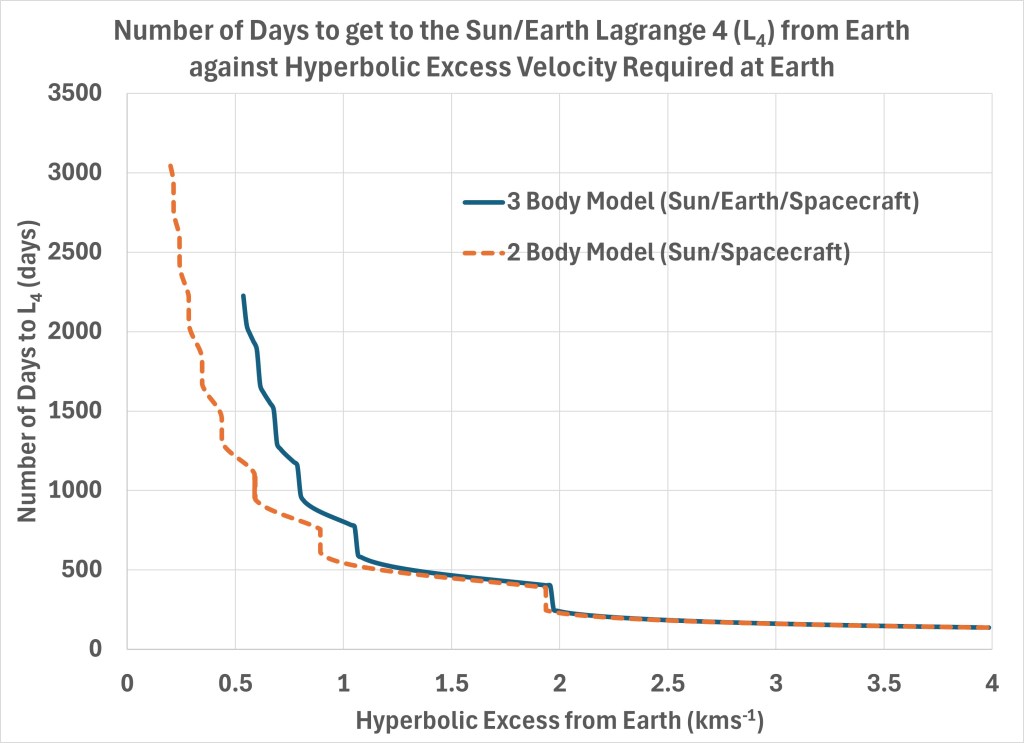
In these plots, the red-dashed line represents the 2-body problem we are addressing in this blog post, and for information the dark blue solid line indicates the 3-body model, with the Earth included.

When you look at the 2-body model in the first of these plots you can observe some ridges which are even more evident in the second plot. These turn out to be harmonics. They are also present to a lesser extent in the 3-body simulation.

Let’s look at what is happening a little more deeply.

The synodic period between the craft and Earth,TS, is given by the following expression:

1TS=1TC−1TE(1)\frac{1}{T_S}=\frac{1}{T_C}-\frac{1}{T_E}\qquad (1)

If we wish to reach a point at θ in advance of the Earth in time t, then it follows that approximately:

θ=2πTSt(2)\theta=\frac{2\pi}{T_S}t\qquad (2)

Let us say we wish to reach the S/E L4 point, thus θ=π/3 , and so:

t=16TS(3)t=\frac{1}{6}T_S\qquad (3)

Furthermore we wish elapsed time to be some integer multiple, n, of the craft’s time period TC, whence:

nTC=16TS(4)nT_C=\frac{1}{6}T_S\qquad (4)

Inserting this into (1) we get:

1nTC=1TC−1TE(5)\frac{1}{nT_C}=\frac{1}{T_C}-\frac{1}{T_E}\qquad (5)

Now rearranging to get TC , we find:

$latex \displaystyle T_C = T_E\frac{6n}{6n-1}$

Thus:

TC=TE6n6n−1T_C=T_E\frac{6n}{6n-1}

From (3) & (4), this leads to a time required to reach L4 as:

TC=TE(1−16n)(6)T_C=T_E\left(1-\frac{1}{6n}\right)\qquad (6)

Let us now determine the theoretical hyperbolic excess speed, V∞, needed at Earth to allow a passage to the L4. We know the time-period of the orbit of the spacecraft, TC, how does that translate to, V∞ ?

First we find from Kepler’s third law that, given the ratio TC/TE, then the ratio of semi-major axes, ac/aE , is given by:

t=TE(n−16)(7)t=T_E\left(n-\frac{1}{6}\right)\qquad (7)

The heliocentric velocity, VC , of the spacecraft when it returns to 1 au is described in the following equation from the well-known orbital energy relationship:

aCaE=(TCTE)23(8)\frac{a_C}{a_E}=\left(\frac{T_C}{T_E}\right)^{\frac{2}{3}}\qquad (8)
VC=2μ(1aE−12aC)(9)V_C=\sqrt{2\mu\left(\frac{1}{a_E}-\frac{1}{2a_C}\right)}\qquad (9)

The hyperbolic excess needed at Earth is then:

V∞=VE−VC=μaE−2μ(1aE−12aC)(10)V_{\infty}=V_E-V_C =\sqrt{\frac{\mu}{a_E}} -\sqrt{2\mu\left(\frac{1}{a_E}-\frac{1}{2a_C}\right)} \qquad (10)

Using equation (8) and with the identity, T =2 π √(a3/μ) , then we can restate equation (10) in terms of time periods as follows:

V∞=(2πμTE)13[1−2−(TETC)23]V_{\infty} = \left(\frac{2\pi\mu}{T_E}\right)^{\frac{1}{3}} \left[ 1-\sqrt{2-\left(\frac{T_E}{T_C}\right)^{\frac{2}{3}}} \right]
V∞=VE[1−2−(6n6n−1)23](11)V_{\infty} = V_E\left[ 1-\sqrt{2-\left(\frac{6n}{6n-1}\right)^{\frac{2}{3}}} \right] \qquad (11)

The L5 Point.

For this we note that the RHS of (1) & (5) must be changed in sign, like so:

1TS=1TE−1TC(12)\frac{1}{T_S}=\frac{1}{T_E}-\frac{1}{T_C}\qquad (12)

We then follow a similar line of reasoning to arrive at:

TC=TE(1+16n)(13)T_C=T_E\left(1+\frac{1}{6n}\right)\qquad (13)

Also note that equation (10) now changes to:

V∞=VC−VE=2μ(1aE−12aC)−μaE(14)V_{\infty}=V_C-V_E = \sqrt{2\mu\left(\frac{1}{a_E}-\frac{1}{2a_C}\right)} -\sqrt{\frac{\mu}{a_E}} \qquad (14)

From which we eventually obtain:

V∞=VE[2−(6n6n+1)23−1](15)V_{\infty} = V_E\left[ \sqrt{2-\left(\frac{6n}{6n+1}\right)^{\frac{2}{3}}}-1 \right] \qquad (15)


Primary Sidebar

Blog

What is 1998 KY26?

6 August 2026

Adam Hibberd I was recently referred to a paper by Farnocchia et al which apparently, so was it argued, contradicted the notion that 1998 KY26 could be technogenic (man made), in other words a spacecraft. For the uninitiated, 1998 KY26 has always been considered (up-to-recently at least) a Near Earth Asteroid (NEA) of some form […]

Members Newsletter – July

31 July 2026

News from i4is I4is return to the Royal Institution, London, UKTwo more of our popular workshops “Skateboards to Starships” are returning this summer to the Royal Institution, 21 Albemarle St, London W1S 4BS.24 August 2026 see https://www.rigb.org/whats-on/holiday-workshops-skateboards-starships-year-10-1325 August 2026 see https://www.rigb.org/whats-on/holiday-workshops-skateboards-starships-year-7-9 Europlanet Science Congress 2026The Europlanet Conference takes place in The Hague, The Netherlands from […]

The Clock is Ticking on Project Lyra

25 July 2026

Adam Hibberd Where are the Interstellar Objects (ISOs)? A new observatory (Vera C. Rubin) has been operating for a month and has not yet found any. A month of Vera C. Rubin is probably not long enough for scientists to change models of their abundance. If nothing after a year? Maybe scientists might start considering […]

Members Newsletter – June

30 June 2026

There’s no shortage of incredible interstellar content to choose from this month. I4is researchers published! Preliminary Analysis into the Feasibility of Missions to Asteroid 2024 YR4We are delighted that our lead astrodynamicist Adam Hibberd and our friend T Marshall Eubanks (Space Initiative Inc, USA) have a paper published by the American Institute of Aeronautics and […]

Join i4is for a journey to the stars!

Members get access to exclusive videos. Here's a taster:

Join now

Footer

Contact i4is

Initiative for Interstellar Studies
27/29 South Lambeth Road
London, SW8 1SZ
United Kingdom

info@i4is.org

Starship Blog

How long does it take to get to the Sun/Earth L4 Point from Earth?

What is 1998 KY26?

Members Newsletter – July

The Clock is Ticking on Project Lyra

Donate

The Initiative for Interstellar Studies is entirely dependent upon the goodwill of its volunteer teams, the minor amounts we receive from our activities and the sale of our merchandise but also the kindness of donors. In order to advance our mission of achieving interstellar flight over the next century, we need your help and support. If you are feeling generous we would very much appreciate your help in moving our mission forward. Make a donation » about Donate

  • Shop
  • Donate
  • Privacy & Cookies
  • Contact us

Initiative for Interstellar Studies Limited
27-29 South Lambeth Road, London, SW8 1SZ
Company Limited by Guarantee No: 09062458 (England and Wales)
Copyright © Initiative for Interstellar Studies · Built by Jason King

Manage Cookie Consent
To provide the best experiences, we use technologies like cookies to store and/or access device information. Consenting to these technologies will allow us to process data such as browsing behaviour or unique IDs on this site. Not consenting or withdrawing consent, may adversely affect certain features and functions.
Functional Always active
The technical storage or access is strictly necessary for the legitimate purpose of enabling the use of a specific service explicitly requested by the subscriber or user, or for the sole purpose of carrying out the transmission of a communication over an electronic communications network.
Preferences
The technical storage or access is necessary for the legitimate purpose of storing preferences that are not requested by the subscriber or user.
Statistics
The technical storage or access that is used exclusively for statistical purposes. The technical storage or access that is used exclusively for anonymous statistical purposes. Without a subpoena, voluntary compliance on the part of your Internet Service Provider, or additional records from a third party, information stored or retrieved for this purpose alone cannot usually be used to identify you.
Marketing
The technical storage or access is required to create user profiles to send advertising, or to track the user on a website or across several websites for similar marketing purposes.
  • Manage options
  • Manage services
  • Manage {vendor_count} vendors
  • Read more about these purposes
View preferences
  • {title}
  • {title}
  • {title}