Adam Hibberd
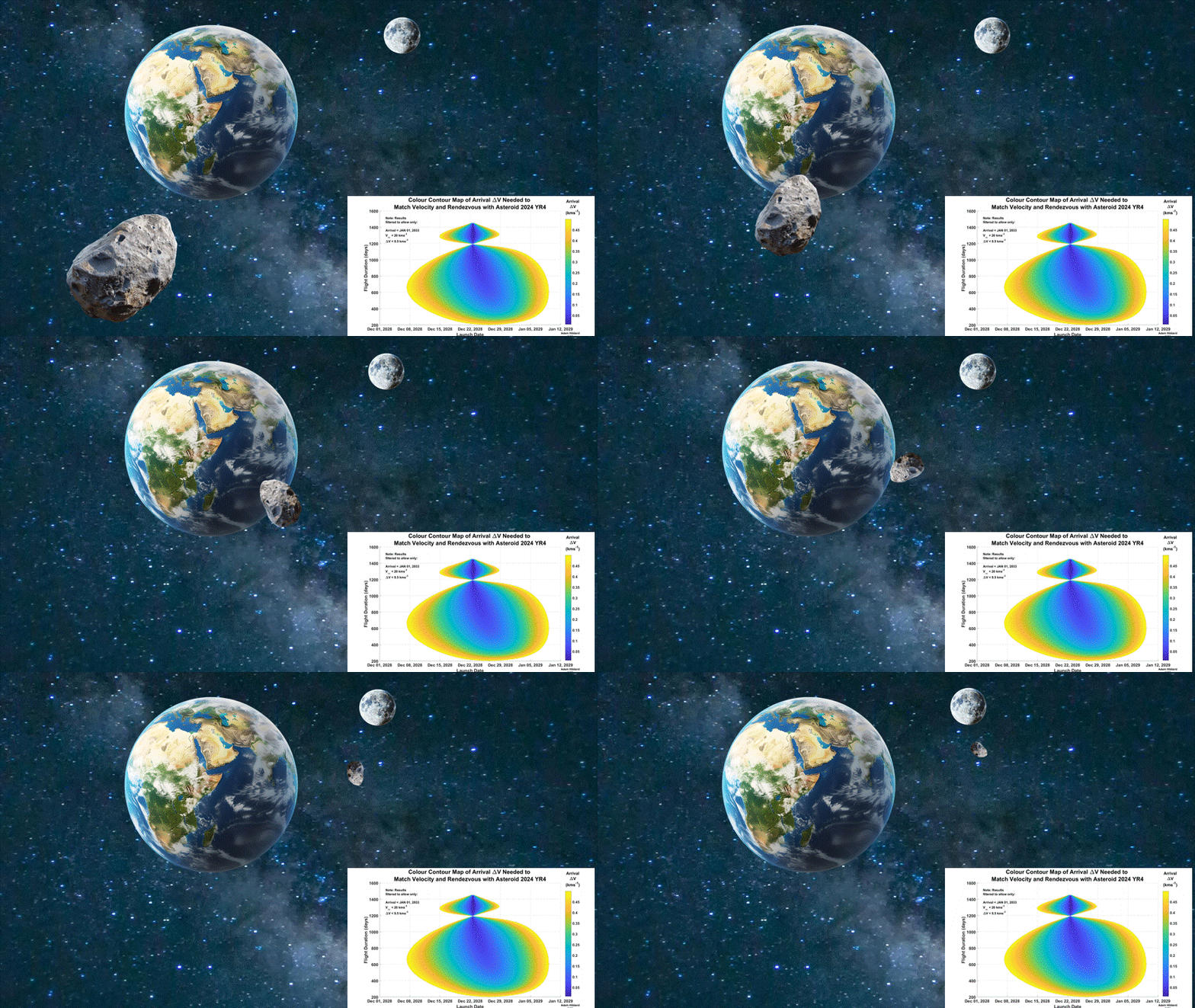
The object known as 2024 YR4 has laid down the gauntlet on humanity. 'See me outside, or take the consequences!'
The consequences however would not be eternal dishonour and ignominy, but a complacent denial of the existential threat posed by Near Earth Asteroids (NEAs) such as this.
True, a few weeks after its discovery in December 2024, 2024 YR4 was determined to have a zero probability of impacting the Earth in December 2032, yet subsequent to this, it was calculated to have a >4% probability of colliding with the Moon.
With further observations recently by the JWST, any collision of the Moon around this timeline can be totally discounted, go here. Thus this finding has been accompanied by much relief since such an impact would have sent huge quantities of debris up into cislunar space, a fair proportion of this debris showering down upon the Moon's surface and creating a serious hazard for any astronauts or taikonauts on the Moon at the time.
Even worse, had the impact occurred on a particular region of the Moon (which it quite possibly could have done), this debris would have headed rapidly towards the Earth, possibly stimulating the catastrophic 'Kessler Syndrome' if the debris had impacted any artificial satellites. The Kessler Syndrome is a cascade effect where when one satellite is struck, more space debris is generated striking other satellites and so on. Needless to say the consequences to humanity would be dire now we are so reliant on satellite technology.
So it seems humanity can now put this dreadful outcome aside and instead we can legitimately ask what we could do about sending a rendezvous mission to arrive at the asteroid, collect a sample and then return it to Earth?
Indeed a flyby mission is high on the 2022 Planetary Decadal Survey list of priorities:
"The highest priority planetary defense demonstration mission...should be a rapid-response, flyby reconnaissance mission targeted to a challenging NEO, representative of the population (∼ 50–100 m in diameter) of objects posing the highest probability of a destructive Earth impact"
Yet alternatively, a sample collection mission, of the kind conducted by OSIRIS-REx would involve an even higher scientific return and is eminently worth considering.
OSIRIS-REx had a launch mass of 2,110 kg, is there anyway such a mass could be inserted by a launch vehicle into an eventual rendezvous mission to perform similar feats of analysis on 2024 YR4 as OSIRIS-REx did on Bennu?
My software, OITS (Optimum Interplanetary Trajectory Software) has found two possible trajectories which would allow a rendezvous mission to be realised with a launch on a SpaceX Falcon Heavy Expendable vehicle.
A friend Justin Wing Chung Hui, lead singer of the Coventry group, the Duck Thieves, is also a software engineer, and on my request has created animations of a trajectory solved by OITS with 2 Deep Space Manoeuvres (DSMs) and another with 2 Earth Gravity Assists.
So should we act on this discovery and send a sample return mission?
That is not for the likes of Justin and me to decide.