By the time the Starship reached its destination after centuries of travel time, what history would have passed by back on Earth? Indeed, how would the culture on board the Starship have evolved?
Starship Blog
With the recent creation of the new i4is website, along with the newer blogs, we have included a selection of previous Starship Blog posts from our archive which we hope you will enjoy browsing. If you would like to write an article and have it appear on our web site, then get in touch with us.
I4IS presents at the Scottish Dark Sky Observatory

Rob Swinney and Terry Regan attended a special event at the Scottish Dark Sky Observatory in August. Over two evenings the pair, representing both i4is and the British Interplanetary Society discussed the prospects of real interstellar flight in the near future.
The interstellar minimum
As a part of our educational initiatives, our team has recently put together a small test paper for starship design, known as ‘the interstellar minimum’ after the famous Russian physicist Lev Landau and his ‘theoretical minimum’ entrance exam for university degree programs.
Pluto flyby success

Yesterday the NASA New Horizons spacecraft successfully executed a flyby of the dwarf planet Pluto, one of the Trans-Neptunian objects, to within a distance of just over 12,500 km.
Project Dragonfly: Kickstarter campaign launched
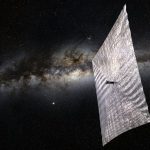
Project Dragonfly is a feasibility study for an interstellar mission, conducted by small, distributed spacecraft, propelled primarily by laser sails. The spacecraft shall be capable of reaching the target star system within a century and be able to decelerate.
The Mariner program

The Mariner program was a joint NASA/JPL initiative which ran from 1962 to 1973 and saw robotic probes sent to nearly all of the planets of the solar system. The program achieved many firsts, including the first planetary flyby, the first pictures from another planet, the first planetary orbiter, the first gravity assist manoeuvre.
To the Voyagers and escaping from the sun

The Voyager 1 and 2 spacecraft were launched in the 1970s. They are now heading out into interstellar space. One day, we may build faster spacecraft and overtake them.
Interplanetary spacecraft programs
When we discuss interplanetary or interstellar missions, it is very difficult to say what is feasible and what is not – the question needs to be qualified. Are we talking about robotic or crewed missions? Flyby or orbital? Small spacecraft or large spacecraft? Lightly or heavily instrumented?
The measure of the Milky Way
We live on a planet, which is in orbit around a star, which is in orbit around a galactic centre on a circular journey that takes around 220 million years. The galactic centre is seen in the constellation Sagittarius from our point of view.
I4IS goes stratospheric at 89,000 ft

We are pleased to report that the launch was a huge success and the balloon flew from Northern Ireland to Oxfordshire. The balloon drifted 100 miles off course but the team were able to recover it. The total flight time was around 3.5 hours.
The Einstein-Rosen Bridge
With the recent box office success of the film ‘interstellar’ many people are excited about the prospects of wormholes as a means for interstellar transport. Although there is currently no evidence that such exotic objects exist in nature, it is possible that they could be artificially created, perhaps from versions of higher dimensional string theory and engineering of the fundamental space-time foam.
Beyond the boundary
The Initiative for Interstellar Studies (i4iS) are proud to bring you our new book, which was edited by Executive Director Kelvin F.Long. This volume, took a year in the making and contains chapter contributions from some of the leading lights in the field of interstellar studies.