
We are very proud to announce that we have submitted a Mission Concept White Paper for the Decadal Survey on missions to interstellar objects: “Interstellar Now! Missions to and Sample Returns from Nearby Interstellar Objects” This was an intense collaborative effort between a group of international researchers: Andreas M. Hein (i4is), T. Marshall Eubanks (i4is/Space […]
Starship Blog
With the recent creation of the new i4is website, along with the newer blogs, we have included a selection of previous Starship Blog posts from our archive which we hope you will enjoy browsing. If you would like to write an article and have it appear on our web site, then get in touch with us.
Reaching 1I/’Oumuamua via Nuclear Thermal Rockets – A Gamechanger

Our Project Lyra Team has come up with an analysis of using nuclear thermal rockets for reaching the interstellar object 1I/’Oumuamua. It turns out that drastic reductions in mission duration (< 14 years for a launch in 2031) and spacecraft mass (1000s of kg vs. 100s of kg for conventional chemical propulsion) are possible.
i4is Magnetic Sail Paper in Acta Astronautica

We are very excited to share with you the publication of Nikolaos Perakis’ first single-authored paper in Elsevier’s peer-reviewed journal “Acta Astronautica”. The paper entitled “Maneuvering through solar wind using magnetic sails” explores the use of magnetic sails for interplanetary missions and can be accessed free of charge for the next 45 days using the […]
i4is Decadal Survey White Paper submitted
In collaboration with Space Initiatives (T. Marshall Eubanks) and the Paris Observatory (Jean Schneider), we have submitted the White Paper „Exobodies in Our Back Yard: Science from Missions to Nearby Interstellar Objects“, based on our work on Project Lyra. The Decadal Survey White Papers are a crucial first step towards defining future NASA missions in […]
The Cathedral and the Starship
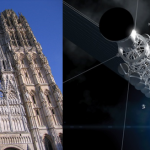
What can we learn from cathedral builders from the Middle Ages for building a starship? In a blog article on Centauri Dreams, our Executive Director Andreas Hein elaborates on this question and provides some surprising answers.
Project Lyra on the Spaceshow
Adam Hibberd, a key member of Project Lyra, gave an interview for the Spaceshow, explaining in depth a mission to ‘Oumuamua, based on his OITS trajectory analysis tool. The recording can be found here.
With Laser Sails to ‘Oumuamua

In a new article, Adam Hibberd and Andreas M. Hein analyse how the interstellar object ‘Oumaumua could be reached via laser sails. They provide a trajectory analysis and the operations of the beaming infrastructure.
Limitless Space Institute Student Contest announced!
Why human exploration of the outer solar system and the stars? Due to COVID-19 issues, the Limitless Space Institute (LSI) is unable to host student interns during the summer of 2020. As an alternate approach to still be able to engage with students on the topic of bold space exploration, LSI will instead sponsor and […]
The Case for a Space Economy

Thermodynamic limits to economic growth on Earth – Can space save us? This new paper argues that continued economic growth on Earth will hit a thermodynamic limit within the third millenium, if economic activities and energy consumption cannot be decoupled. The maximum size would be up to 7000 times the current one. An in-space economy […]
i4is Self-Replicating Probe

i4is concept for a near-term self-replicating probe – The potential to drastically increase the efficiency of space exploration!https://arxiv.org/ftp/arxiv/papers/2005/2005.12303.pdf. Beautifully illustrated by Adrian Mann!
Principium 29 now released!
Issue 29 of Principium, the quarterly publication of the Initiative for Interstellar Studies is now published. The front cover image is a Bussard Ramjet – a new piece produced for i4is by our friend and esteemed artist Alex Storer (thelightdream.net).
ISU–i4is Interstellar Module concluded!

The ISU – i4is Interstellar Module ended today with four awesome presentations on world ship topics, each one venturing into areas no human has visited before! A big thank you to Prof. Chris Welch and the amazing MSS20 students who worked very hard on this for the last two weeks! Also, thank you to the […]